
- Buy Crypto
- Markets
 Futures
- Spot
- Copy Trade
 Earn
Earn- More
"2.5 Dip" Real Reason: Wall Street Deleveraging Induced Overreaction

Original Title: So what happened on 2/5?
Original Author: Jeff Park, Bitwise Advisor
Original Translation: Ding Dang, Odaily Planet Daily
Editor's Note: On February 5th, the crypto market once again experienced a sharp decline, with a 24-hour liquidation scale exceeding $26 billion, and Bitcoin briefly plummeting to $60,000. However, the market does not seem to have reached a clear consensus on the cause of this decline. Bitwise Advisor Jeff Park, from the perspective of options and hedging mechanisms, provided a new analysis framework.
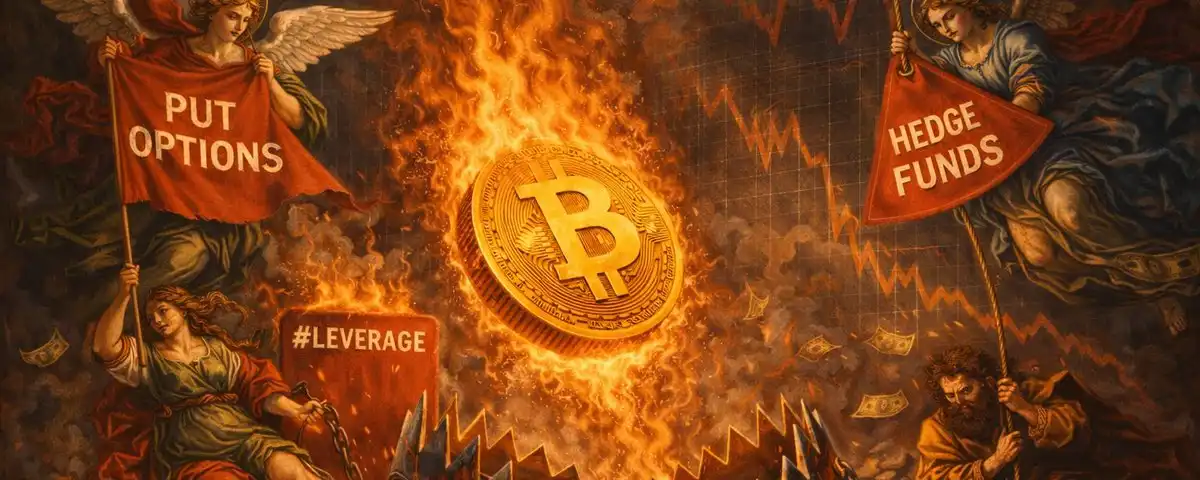
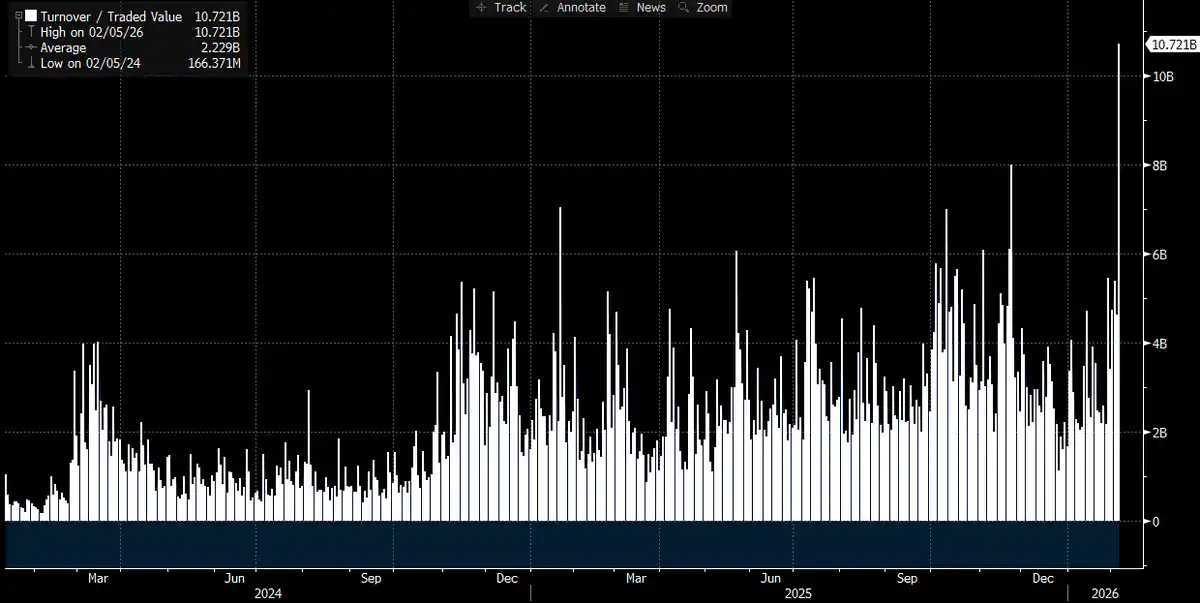
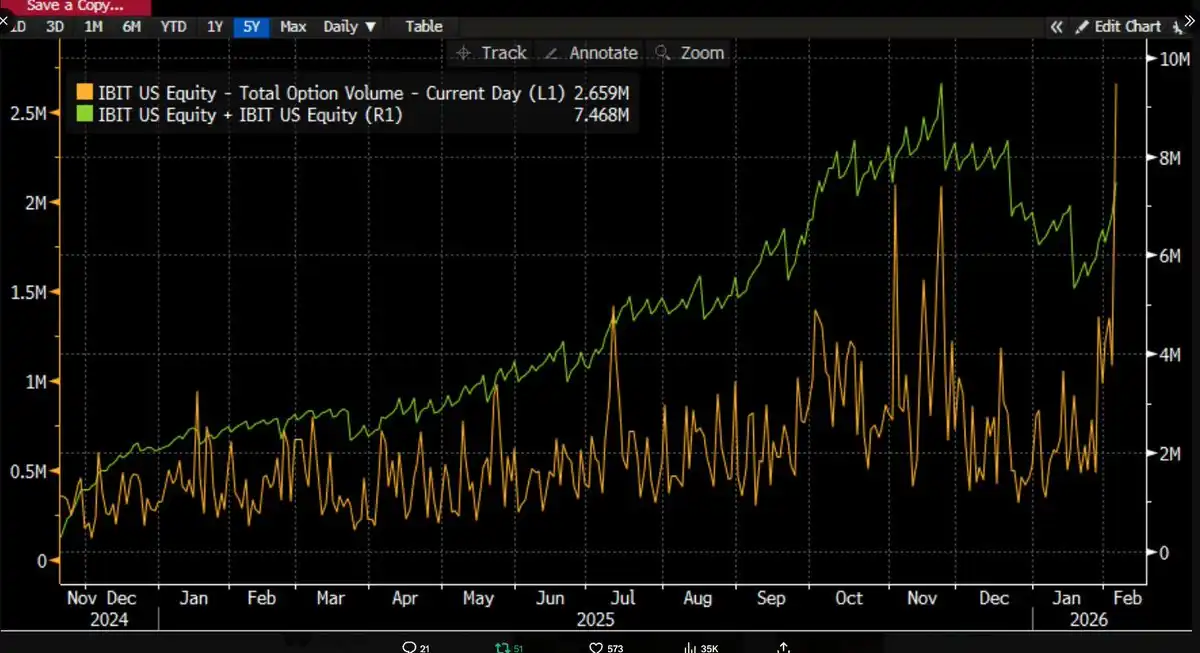
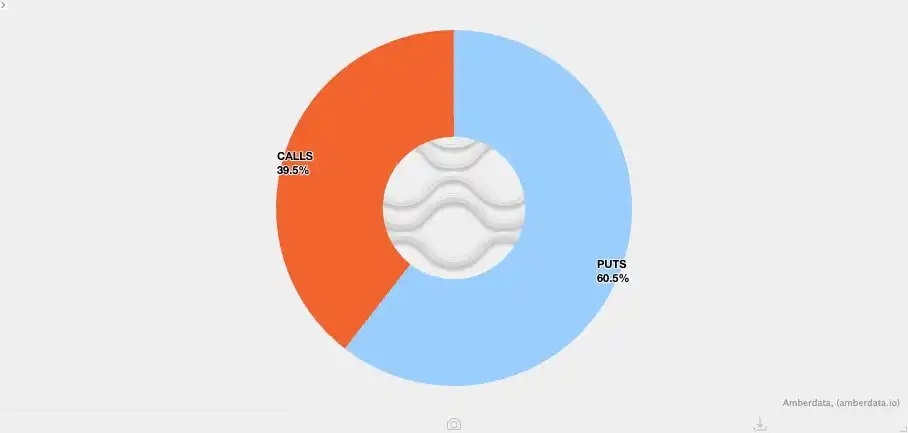
As time passed and more data continued to be disclosed, the situation became increasingly clear: this violent sell-off was likely related to a Bitcoin ETF, and the day itself was one of the most intense trading days in the capital market in recent years. We were able to make this judgment because IBIT's trading volume that day hit a historic high—trading volume exceeded $100 billion, doubling the previous record (truly an astonishing number). At the same time, the options trading volume also hit a record high (as shown in the chart below, the highest number of contracts since the ETF was launched). Somewhat unusually compared to the past, from the structure of the trading volume, this time the options trading was clearly dominated by put options, rather than call options (this point will be further elaborated later on).
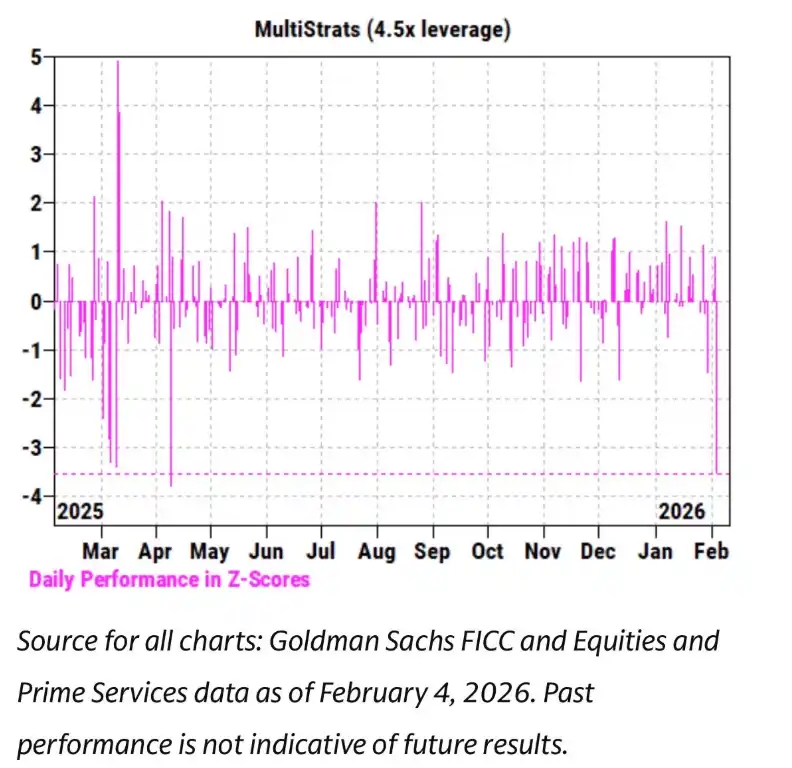
At the same time, over the past few weeks, we have observed an extremely close correlation between IBIT's price trend and software stocks and other risk assets. Goldman Sachs' Prime Brokerage (PB) team also released a report pointing out that February 4th was one of the worst-performing days on record for multi-strategy funds, with a Z-score of 3.5. This means it was an extreme event with a probability of only 0.05%, ten times rarer than a 3-sigma event (the classic "black swan" threshold, with a probability of about 0.27%). It can be said that this was a catastrophic shock. Typically, it is after such an event that multi-strategy funds (pod shop) risk managers would promptly intervene and require all trading teams to deleverage immediately, indiscriminately, and urgently. This explains why February 5th also turned into a bloodbath.
With so many records being broken and a clear downward price trend (a 13.2% single-day drop), we originally expected to see ETF net outflows. Referring to historical data, such an expectation is not far-fetched: for example, on January 30, following a 5.8% drop the previous trading day, IBIT saw a record $530 million redemption; or on February 4, with ongoing declines, IBIT had around a $370 million redemption. Therefore, in the market environment of February 5, an outflow of at least $500 million to $1 billion was entirely reasonable.
However, the reality was quite the opposite — what we saw was widespread net purchases. IBIT added approximately 6 million shares that day, corresponding to a growth of over $230 million in assets under management. At the same time, other Bitcoin ETFs also saw inflows, with the entire ETF system attracting over $300 million in net inflows.
This result is somewhat perplexing. In theory, one could argue that the strong price rebound on February 6 somewhat alleviated redemption pressure, but to shift directly from "potential reduced outflows" to "net inflows" is a whole different story. This implies that there were likely multiple factors at play simultaneously, but these factors do not form a single, linear narrative. Based on the information currently available to us, several reasonable assumptions can be made, and upon these assumptions, I will present my overall inference.
First, this round of Bitcoin sell-off likely touched upon some form of non-pure, crypto-native multi-asset investment portfolio or strategy. This could be the aforementioned multi-strategy hedge fund, or it could be a model portfolio business similar to BlackRock's, allocating between IBIT and IGV (software ETF) and being forced to auto-rebalance funds amid intense volatility.
Second, the acceleration of the Bitcoin sell-off is likely related to the options market, especially to options structures associated with the downside direction.
Third, this sell-off did not ultimately translate into outflows at the Bitcoin asset level, indicating that the primary driving force behind the rally came from the "paper money system," dominated by traders and market makers engaged in position adjustments overall in a hedged state.
Based on the above facts, my current core assumptions are as follows.
1. The direct catalyst for this sell-off was a broad deleveraging triggered by multi-asset funds and portfolios when the downside correlation of risk assets reached statistically anomalous levels.
2. This process then triggered an extremely intense deleveraging cycle, which also included Bitcoin risk exposure, but a considerable part of the risk was actually in a "Delta-Neutral" hedge position, such as basis trading, relative value trading (such as Bitcoin relative to crypto equities), and other structures usually used by trading firms to "box in" the remaining Delta risk.
3. This deleveraging cycle then triggered a short Gamma effect, further amplifying the downward pressure, forcing trading firms to sell IBIT. However, due to the excessive selling pressure, market makers had to engage in net short selling of Bitcoin without considering their own inventory. This process actually created new ETF inventory, reducing the market's original expectation of large-scale fund outflows.
Subsequently, on February 6th, we observed positive fund inflows into IBIT, with some IBIT buyers (the question remains which category these buyers belong to) choosing to buy on dips after the decline, further offsetting the potential minor net outflows.
Firstly, I personally tend to believe that the initial catalyst of this event came from the sell-off of software stocks, especially considering the high correlation between Bitcoin and software stocks, even higher than its correlation with gold. Please refer to the two charts below.
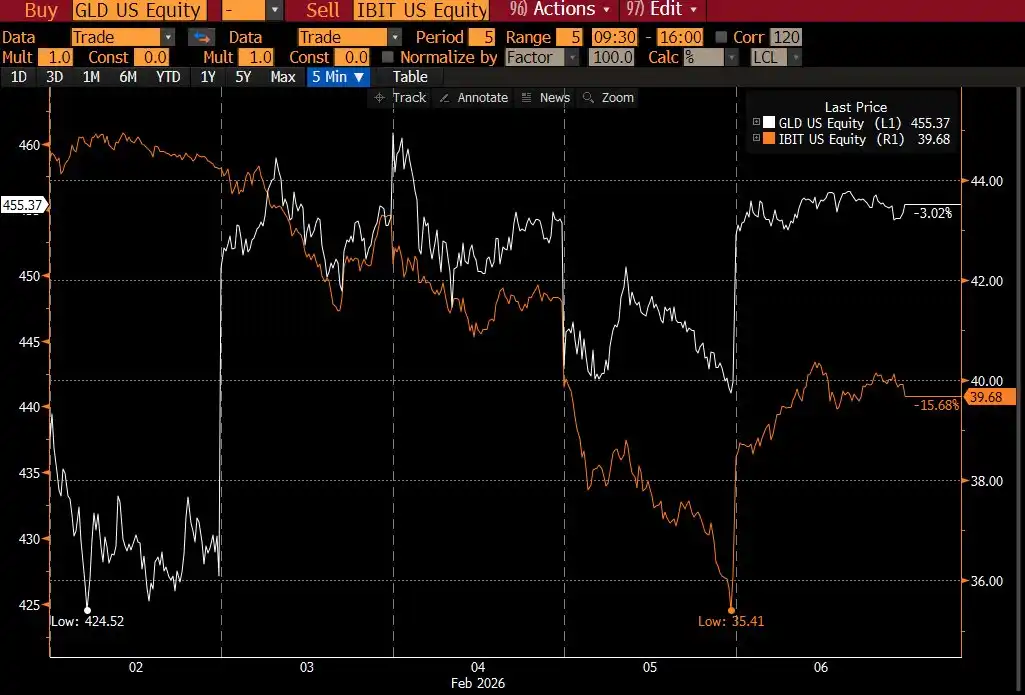
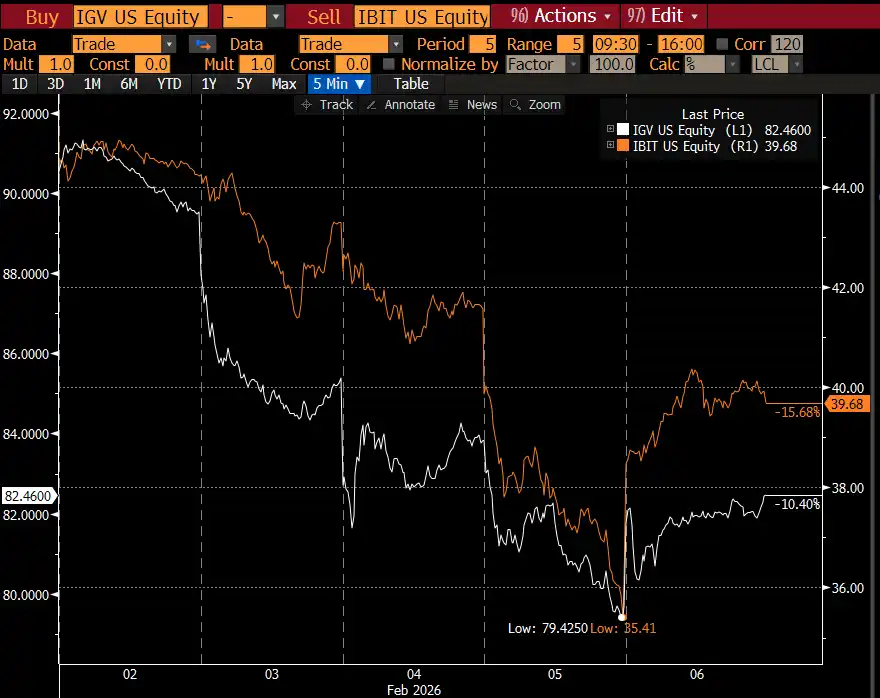
This logically makes sense because gold is usually not an asset held in large quantities by multi-strategy funds engaged in leveraged trading, although it may appear in RIA model portfolios (a set of pre-designed asset allocation schemes). Therefore, in my view, this further confirms a judgment: the center of this round of turmoil is more likely within the multi-strategy fund system.
And therefore, the second judgment seems more reasonable, namely, this intense deleveraging process indeed included Bitcoin risk in a hedged state. Taking the CME Bitcoin basis trading as an example, this has been one of the most preferred trading strategies for multi-strategy funds for a long time.

Looking at the complete data from January 26th to yesterday, covering CME Bitcoin basis trends for 30, 60, 90, 120 days (thanks to top industry researcher @dlawant for providing the data), it is clear to see that the near-month basis surged from 3.3% to as high as 9% on February 5th. This is one of the largest magnitude surges we have personally observed in the market since the ETF launch, almost conclusively pointing to one conclusion: basis trading was massively liquidated by order flow.
Consider for a moment institutions like Millennium and Citadel, forced to unwound basis trading positions (selling spot, buying futures). Given their footprint in the Bitcoin ETF ecosystem, it’s not hard to understand why this action would cause a severe impact on the overall market structure. I have previously written my own musings on this.
Editor's note: The current indiscriminate selling pressure, likely originating from the U.S., is probably from multi-strategy hedge funds. These funds often employ delta hedging strategies or run some sort of relative value (RV) or factor-neutral trades, which are currently widening spreads, potentially accompanied by growth stock equity beta spillover.
A rough estimate: about 1/3 of the Bitcoin ETF is institutionally held, with approximately 50% (possibly more) considered hedge fund holdings. This is a significant chunk of hot money flow, and once financing costs or margin requirements increase in the current high-volatility environment, risk managers intervene, these funds are quick to capitulate, especially when the basis returns no longer justify the risk premium. Worth noting, today MSTR's USD trading volume is one of the highest in its history.
This is why the biggest factor that makes hedge funds most vulnerable to collapse is the infamous "common holder risk": multiple seemingly independent funds holding highly similar exposures, when the market goes down, all rushing to the same narrow exit, causing all downside correlations to tend to 1. Selling in such poor liquidity as we see today is typical "fire sale" behavior, which we are witnessing today. Ultimately, this will be reflected in the ETF fund flow data. If this assumption holds, once all this unwinds, I suspect prices will reprice rapidly, but then rebuilding confidence will take some time.
This brings us to the third clue. Now that we understand why IBIT is being sold off in a widespread deleveraging context, the question becomes: what is accelerating the downturn? One possible "accelerant" is structured products. While I don't believe the size of the structured products market is enough to single-handedly trigger this selloff, when all factors align in a way that is extraordinarily and perfectly out of line with any Value at Risk (VaR) model's expectations, they can absolutely become a catalytic event triggering a chain liquidation event.
This immediately reminds me of my experience working at Morgan Stanley. There, structured products with knock-in put barriers (options that only "activate" as valid put options when the underlying asset price hits/crosses a specific barrier level) often had extremely destructive consequences. In certain cases, the change in option Delta could even exceed 1, a phenomenon that the Black-Scholes model didn't even consider—because in the standard Black-Scholes framework, for regular vanilla options (the most basic European call/put options), option delta can never exceed 1.
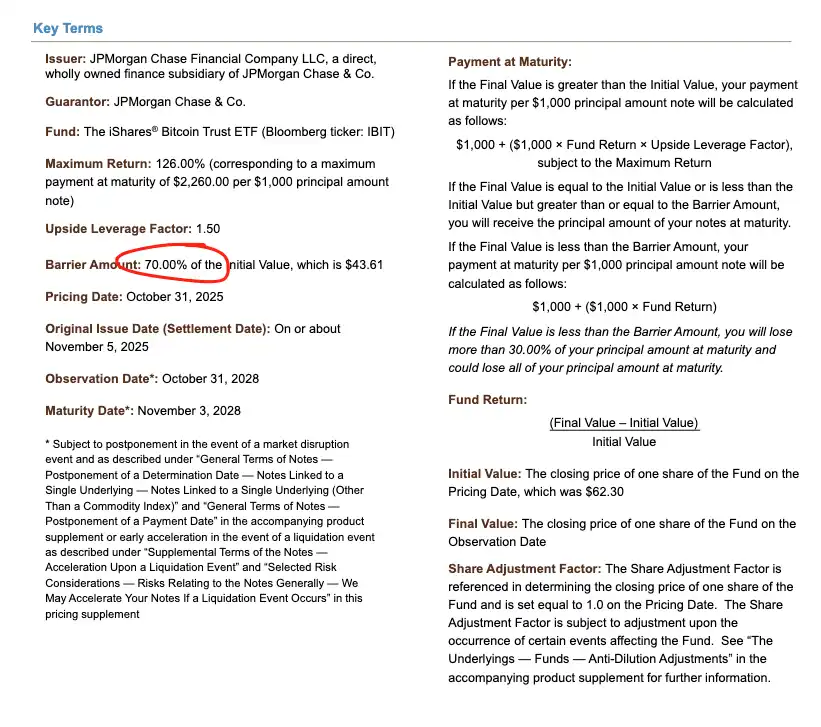
Using a note priced by JPMorgan in November of last year as an example, we can see that its barrier knock-in level was set exactly at 43.6. If these notes continue to be issued in December, and the Bitcoin price drops by another 10%, we can imagine a large accumulation of knock-in barriers in the 38–39 range, which is precisely the so-called "eye of the storm".
In the event that these barriers are breached, if traders have hedged the knock-in risk by selling put options, the speed of Gamma's change under negative Vanna dynamics will be extremely rapid. At this point, as a trader, the only feasible response is to aggressively sell the underlying asset in a weakening market. This is exactly what we observe: implied volatility (IV) collapsing to near its historical low of 90%, almost reaching a catastrophic level of squeezing. In this scenario, traders have to increase their IBIT short position to ultimately create new net ETF shares. This part indeed requires a certain amount of speculative space and is difficult to confirm without more detailed spread data, but considering the record-breaking volume of the day and the deep involvement of Authorized Participants (AP), this situation is entirely plausible.
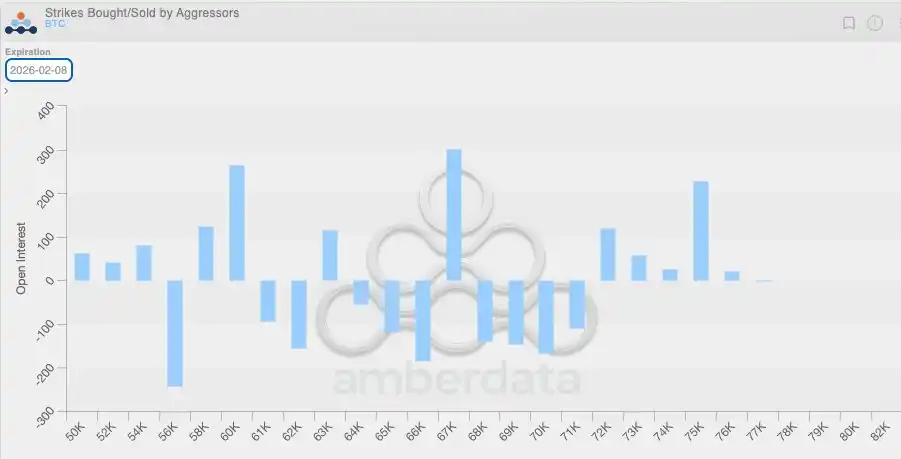
Combining this negative Vanna dynamic with another fact makes the logic clearer. Due to a period of overall low volatility, clients in the crypto-native market have been generally inclined to buy put options in recent weeks. This means that crypto traders themselves are in a natural short Gamma state and have underestimated the potential for future high volatility in pricing. When a truly significant market move occurs, this structural imbalance further amplifies downward pressure. The position distribution chart below clearly illustrates this, showing that in the $64K to $71K range, traders are primarily concentrated in short Gamma positions in put options.
This brings us back to February 6th, when Bitcoin saw a more than 10% powerful rebound. An interesting observation on that day was that the CME's open interest (OI) expanded at a significantly faster rate than Binance's (also thanks to @dlawant for aligning hourly data to EST 4 pm). From February 4th to 5th, the distinct collapse of CME OI is evident, once again confirming the large-scale unwinding of basis trades on February 5th; and on February 6th, these positions may have been rebuilt to take advantage of higher basis levels, offsetting the outflow of funds.
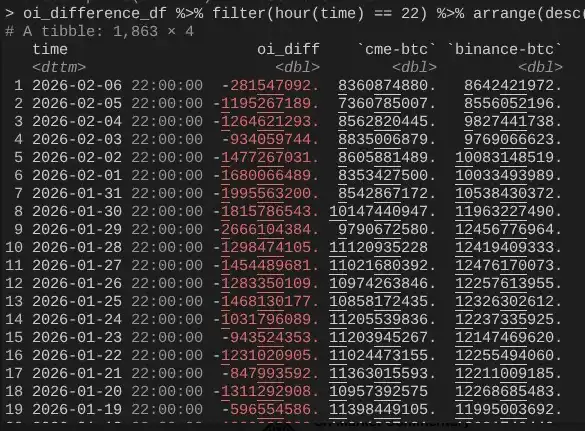
The entire logic chain has now closed loop: IBIT remains roughly flat at the subscription and redemption level, as CME basis trading has resumed; however, the price remains low because Binance's Open Interest has significantly collapsed, indicating that a considerable amount of deleveraging pressure is coming from the crypto-native market's short Gamma positions and liquidation behavior.
So here is my best explanation of the market performance on February 5 and subsequent to February 6. This deduction is based on several assumptions and is not entirely satisfactory because it does not have a clear "culprit" to blame (like the FTX incident). But the core conclusion is this: The trigger for this round of sell-off came from traditional financial derisking behavior outside of crypto, which conveniently pushed the Bitcoin price into a range where downward acceleration due to short Gamma hedging behavior would occur. This decline was not driven by directional bearish views but by hedging demand, and eventually swiftly reversed on February 6 (unfortunately, this reversal primarily benefited market-neutral funds in traditional finance rather than directional strategies in crypto-native). Although this conclusion may not be exciting, at least it can be somewhat reassuring that the previous day's sell-off most likely had nothing to do with the 10/10 event.
Yes, I do not believe that last week's events were a continuation of the 10/10 deleveraging process. I read an article suggesting that the turmoil may have originated from a non-U.S.-based fund headquartered in Hong Kong, which was involved in yen basis trading and ultimately failed. However, this theory has two obvious flaws. First, I do not believe there would be a non-crypto prime broker willing to provide services for such a complex multi-asset trade while offering a 90-day margin cushion and not already collapsing into insolvency when the risk framework tightened. Second, if the basis trading funds were trying to "escape" by buying IBIT options, then a Bitcoin price drop itself would not accelerate the risk release—the options would simply go out of the money, with their Greeks rapidly approaching zero. This means that the trade itself must involve real downside risk. If someone is long the USD/JPY basis while selling IBIT put options, then such a prime broker, frankly speaking, does not deserve to continue to exist.
The next few days will be crucial as we will have more data to determine if investors are taking advantage of this dip to build new demand, which would be a very bullish signal. At the moment, I am quite excited about the potential inflow of ETF funds. I still believe that true RIA-style ETF buyers (not relative value-oriented hedge funds) are insightful investors, and at the institutional level, we are seeing a lot of genuine and profound progress, a fact that is evident throughout the industry's advancement and among my friends at Bitwise. Therefore, I am focusing on those net inflows that have not been accompanied by basis trading expansion.
Lastly, all of this once again demonstrates that Bitcoin has integrated into the global financial capital market in an extremely complex and mature way. This also means that when the market is positioned for a short squeeze in the future, the uptrend will be steeper than ever before.
The fragility of traditional financial margin rules is exactly Bitcoin's antifragility. Once the price rebounds—inevitable in my view, especially after Nasdaq raised the options' open interest ceiling—it will be a spectacular rally.
You may also like

Key Market Information Discrepancy on February 9th - A Must-See! | Alpha Morning Report

Kyle's review of Hyperliquid sparks controversy, Solitude Bank officially opens, what are the overseas crypto communities talking about today?

Cryptocurrency prices in the dumps, but the prediction market is going wild?

Decoding Strategy’s Latest Financial Report: After a $12.4 Billion Loss, How Long Can the Bitcoin Flywheel Keep Spinning?
When earnings reports become electrocardiograms of Bitcoin’s price, Strategy is not merely a company—it’s an experiment testing whether faith can overcome gravity.

Discover How to Participate in Staking
Staking is a digital asset yield product launched by the WEEX platform. By subscribing to Staking products, users can stake their idle digital assets and earn corresponding Staking rewards.

WEEX AI Trading Hackathon Rules & Guidelines
This article explains the rules, requirements, and prize structure for the WEEX AI Trading Hackathon Finals, where finalists compete using AI-driven trading strategies under real market conditions.

From 0 to $1 Million: Five Steps to Outperform the Market Through Wallet Tracking

Token Cannot Compound, Where Is the Real Investment Opportunity?

February 6th Market Key Intelligence, How Much Did You Miss?

China's Central Bank and Eight Other Departments' Latest Regulatory Focus: Key Attention to RWA Tokenized Asset Risk
Foreword: Today, the People's Bank of China's website published the "Notice of the People's Bank of China, National Development and Reform Commission, Ministry of Industry and Information Technology, Ministry of Public Security, State Administration for Market Regulation, China Banking and Insurance Regulatory Commission, China Securities Regulatory Commission, State Administration of Foreign Exchange on Further Preventing and Dealing with Risks Related to Virtual Currency and Others (Yinfa [2026] No. 42)", the latest regulatory requirements from the eight departments including the central bank, which are basically consistent with the regulatory requirements of recent years. The main focus of the regulation is on speculative activities such as virtual currency trading, exchanges, ICOs, overseas platform services, and this time, regulatory oversight of RWA has been added, explicitly prohibiting RWA tokenization, stablecoins (especially those pegged to the RMB). The following is the full text:
To the people's governments of all provinces, autonomous regions, and municipalities directly under the Central Government, the Xinjiang Production and Construction Corps:
Recently, there have been speculative activities related to virtual currency and Real-World Assets (RWA) tokenization, disrupting the economic and financial order and jeopardizing the property security of the people. In order to further prevent and address the risks related to virtual currency and Real-World Assets tokenization, effectively safeguard national security and social stability, in accordance with the "Law of the People's Republic of China on the People's Bank of China," "Law of the People's Republic of China on Commercial Banks," "Securities Law of the People's Republic of China," "Law of the People's Republic of China on Securities Investment Funds," "Law of the People's Republic of China on Futures and Derivatives," "Cybersecurity Law of the People's Republic of China," "Regulations of the People's Republic of China on the Administration of Renminbi," "Regulations on Prevention and Disposal of Illegal Fundraising," "Regulations of the People's Republic of China on Foreign Exchange Administration," "Telecommunications Regulations of the People's Republic of China," and other provisions, after reaching consensus with the Cyberspace Administration of China, the Supreme People's Court, and the Supreme People's Procuratorate, and with the approval of the State Council, the relevant matters are notified as follows:
(I) Virtual currency does not possess the legal status equivalent to fiat currency. Virtual currencies such as Bitcoin, Ether, Tether, etc., have the main characteristics of being issued by non-monetary authorities, using encryption technology and distributed ledger or similar technology, existing in digital form, etc. They do not have legal tender status, should not and cannot be circulated and used as currency in the market.
The business activities related to virtual currency are classified as illegal financial activities. The exchange of fiat currency and virtual currency within the territory, exchange of virtual currencies, acting as a central counterparty in buying and selling virtual currencies, providing information intermediary and pricing services for virtual currency transactions, token issuance financing, and trading of virtual currency-related financial products, etc., fall under illegal financial activities, such as suspected illegal issuance of token vouchers, unauthorized public issuance of securities, illegal operation of securities and futures business, illegal fundraising, etc., are strictly prohibited across the board and resolutely banned in accordance with the law. Overseas entities and individuals are not allowed to provide virtual currency-related services to domestic entities in any form.
A stablecoin pegged to a fiat currency indirectly fulfills some functions of the fiat currency in circulation. Without the consent of relevant authorities in accordance with the law and regulations, any domestic or foreign entity or individual is not allowed to issue a RMB-pegged stablecoin overseas.
(II)Tokenization of Real-World Assets refers to the use of encryption technology and distributed ledger or similar technologies to transform ownership rights, income rights, etc., of assets into tokens (tokens) or other interests or bond certificates with token (token) characteristics, and carry out issuance and trading activities.
Engaging in the tokenization of real-world assets domestically, as well as providing related intermediary, information technology services, etc., which are suspected of illegal issuance of token vouchers, unauthorized public offering of securities, illegal operation of securities and futures business, illegal fundraising, and other illegal financial activities, shall be prohibited; except for relevant business activities carried out with the approval of the competent authorities in accordance with the law and regulations and relying on specific financial infrastructures. Overseas entities and individuals are not allowed to illegally provide services related to the tokenization of real-world assets to domestic entities in any form.
(III) Inter-agency Coordination. The People's Bank of China, together with the National Development and Reform Commission, the Ministry of Industry and Information Technology, the Ministry of Public Security, the State Administration for Market Regulation, the China Banking and Insurance Regulatory Commission, the China Securities Regulatory Commission, the State Administration of Foreign Exchange, and other departments, will improve the work mechanism, strengthen coordination with the Cyberspace Administration of China, the Supreme People's Court, and the Supreme People's Procuratorate, coordinate efforts, and overall guide regions to carry out risk prevention and disposal of virtual currency-related illegal financial activities.
The China Securities Regulatory Commission, together with the National Development and Reform Commission, the Ministry of Industry and Information Technology, the Ministry of Public Security, the People's Bank of China, the State Administration for Market Regulation, the China Banking and Insurance Regulatory Commission, the State Administration of Foreign Exchange, and other departments, will improve the work mechanism, strengthen coordination with the Cyberspace Administration of China, the Supreme People's Court, and the Supreme People's Procuratorate, coordinate efforts, and overall guide regions to carry out risk prevention and disposal of illegal financial activities related to the tokenization of real-world assets.
(IV) Strengthening Local Implementation. The people's governments at the provincial level are overall responsible for the prevention and disposal of risks related to virtual currencies and the tokenization of real-world assets in their respective administrative regions. The specific leading department is the local financial regulatory department, with participation from branches and dispatched institutions of the State Council's financial regulatory department, telecommunications regulators, public security, market supervision, and other departments, in coordination with cyberspace departments, courts, and procuratorates, to improve the normalization of the work mechanism, effectively connect with the relevant work mechanisms of central departments, form a cooperative and coordinated working pattern between central and local governments, effectively prevent and properly handle risks related to virtual currencies and the tokenization of real-world assets, and maintain economic and financial order and social stability.
(5) Enhanced Risk Monitoring. The People's Bank of China, China Securities Regulatory Commission, National Development and Reform Commission, Ministry of Industry and Information Technology, Ministry of Public Security, State Administration of Foreign Exchange, Cyberspace Administration of China, and other departments continue to improve monitoring techniques and system support, enhance cross-departmental data analysis and sharing, establish sound information sharing and cross-validation mechanisms, promptly grasp the risk situation of activities related to virtual currency and real-world asset tokenization. Local governments at all levels give full play to the role of local monitoring and early warning mechanisms. Local financial regulatory authorities, together with branches and agencies of the State Council's financial regulatory authorities, as well as departments of cyberspace and public security, ensure effective connection between online monitoring, offline investigation, and fund tracking, efficiently and accurately identify activities related to virtual currency and real-world asset tokenization, promptly share risk information, improve early warning information dissemination, verification, and rapid response mechanisms.
(6) Strengthened Oversight of Financial Institutions, Intermediaries, and Technology Service Providers. Financial institutions (including non-bank payment institutions) are prohibited from providing account opening, fund transfer, and clearing services for virtual currency-related business activities, issuing and selling financial products related to virtual currency, including virtual currency and related financial products in the scope of collateral, conducting insurance business related to virtual currency, or including virtual currency in the scope of insurance liability. Financial institutions (including non-bank payment institutions) are prohibited from providing custody, clearing, and settlement services for unauthorized real-world asset tokenization-related business and related financial products. Relevant intermediary institutions and information technology service providers are prohibited from providing intermediary, technical, or other services for unauthorized real-world asset tokenization-related businesses and related financial products.
(7) Enhanced Management of Internet Information Content and Access. Internet enterprises are prohibited from providing online business venues, commercial displays, marketing, advertising, or paid traffic diversion services for virtual currency and real-world asset tokenization-related business activities. Upon discovering clues of illegal activities, they should promptly report to relevant departments and provide technical support and assistance for related investigations and inquiries. Based on the clues transferred by the financial regulatory authorities, the cyberspace administration, telecommunications authorities, and public security departments should promptly close and deal with websites, mobile applications (including mini-programs), and public accounts engaged in virtual currency and real-world asset tokenization-related business activities in accordance with the law.
(8) Strengthened Entity Registration and Advertisement Management. Market supervision departments strengthen entity registration and management, and enterprise and individual business registrations must not contain terms such as "virtual currency," "virtual asset," "cryptocurrency," "crypto asset," "stablecoin," "real-world asset tokenization," or "RWA" in their names or business scopes. Market supervision departments, together with financial regulatory authorities, legally enhance the supervision of advertisements related to virtual currency and real-world asset tokenization, promptly investigating and handling relevant illegal advertisements.
(IX) Continued Rectification of Virtual Currency Mining Activities. The National Development and Reform Commission, together with relevant departments, strictly controls virtual currency mining activities, continuously promotes the rectification of virtual currency mining activities. The people's governments of various provinces take overall responsibility for the rectification of "mining" within their respective administrative regions. In accordance with the requirements of the National Development and Reform Commission and other departments in the "Notice on the Rectification of Virtual Currency Mining Activities" (NDRC Energy-saving Building [2021] No. 1283) and the provisions of the "Guidance Catalog for Industrial Structure Adjustment (2024 Edition)," a comprehensive review, investigation, and closure of existing virtual currency mining projects are conducted, new mining projects are strictly prohibited, and mining machine production enterprises are strictly prohibited from providing mining machine sales and other services within the country.
(X) Severe Crackdown on Related Illegal Financial Activities. Upon discovering clues to illegal financial activities related to virtual currency and the tokenization of real-world assets, local financial regulatory authorities, branches of the State Council's financial regulatory authorities, and other relevant departments promptly investigate, determine, and properly handle the issues in accordance with the law, and seriously hold the relevant entities and individuals legally responsible. Those suspected of crimes are transferred to the judicial authorities for processing according to the law.
(XI) Severe Crackdown on Related Illegal and Criminal Activities. The Ministry of Public Security, the People's Bank of China, the State Administration for Market Regulation, the China Banking and Insurance Regulatory Commission, the China Securities Regulatory Commission, as well as judicial and procuratorial organs, in accordance with their respective responsibilities, rigorously crack down on illegal and criminal activities related to virtual currency, the tokenization of real-world assets, such as fraud, money laundering, illegal business operations, pyramid schemes, illegal fundraising, and other illegal and criminal activities carried out under the guise of virtual currency, the tokenization of real-world assets, etc.
(XII) Strengthen Industry Self-discipline. Relevant industry associations should enhance membership management and policy advocacy, based on their own responsibilities, advocate and urge member units to resist illegal financial activities related to virtual currency and the tokenization of real-world assets. Member units that violate regulatory policies and industry self-discipline rules are to be disciplined in accordance with relevant self-regulatory management regulations. By leveraging various industry infrastructure, conduct risk monitoring related to virtual currency, the tokenization of real-world assets, and promptly transfer issue clues to relevant departments.
(XIII) Without the approval of relevant departments in accordance with the law and regulations, domestic entities and foreign entities controlled by them may not issue virtual currency overseas.
(XIV) Domestic entities engaging directly or indirectly in overseas external debt-based tokenization of real-world assets, or conducting asset securitization activities abroad based on domestic ownership rights, income rights, etc. (hereinafter referred to as domestic equity), should be strictly regulated in accordance with the principles of "same business, same risk, same rules." The National Development and Reform Commission, the China Securities Regulatory Commission, the State Administration of Foreign Exchange, and other relevant departments regulate it according to their respective responsibilities. For other forms of overseas real-world asset tokenization activities based on domestic equity by domestic entities, the China Securities Regulatory Commission, together with relevant departments, supervise according to their division of responsibilities. Without the consent and filing of relevant departments, no unit or individual may engage in the above-mentioned business.
(15) Overseas subsidiaries and branches of domestic financial institutions providing Real World Asset Tokenization-related services overseas shall do so legally and prudently. They shall have professional personnel and systems in place to effectively mitigate business risks, strictly implement customer onboarding, suitability management, anti-money laundering requirements, and incorporate them into the domestic financial institutions' compliance and risk management system. Intermediaries and information technology service providers offering Real World Asset Tokenization services abroad based on domestic equity or conducting Real World Asset Tokenization business in the form of overseas debt for domestic entities directly or indirectly venturing abroad must strictly comply with relevant laws and regulations. They should establish and improve relevant compliance and internal control systems in accordance with relevant normative requirements, strengthen business and risk control, and report the business developments to the relevant regulatory authorities for approval or filing.
(16) Strengthen organizational leadership and overall coordination. All departments and regions should attach great importance to the prevention of risks related to virtual currencies and Real World Asset Tokenization, strengthen organizational leadership, clarify work responsibilities, form a long-term effective working mechanism with centralized coordination, local implementation, and shared responsibilities, maintain high pressure, dynamically monitor risks, effectively prevent and mitigate risks in an orderly and efficient manner, legally protect the property security of the people, and make every effort to maintain economic and financial order and social stability.
(17) Widely carry out publicity and education. All departments, regions, and industry associations should make full use of various media and other communication channels to disseminate information through legal and policy interpretation, analysis of typical cases, and education on investment risks, etc. They should promote the illegality and harm of virtual currencies and Real World Asset Tokenization-related businesses and their manifestations, fully alert to potential risks and hidden dangers, and enhance public awareness and identification capabilities for risk prevention.
(18) Engaging in illegal financial activities related to virtual currencies and Real World Asset Tokenization in violation of this notice, as well as providing services for virtual currencies and Real World Asset Tokenization-related businesses, shall be punished in accordance with relevant regulations. If it constitutes a crime, criminal liability shall be pursued according to the law. For domestic entities and individuals who knowingly or should have known that overseas entities illegally provided virtual currency or Real World Asset Tokenization-related services to domestic entities and still assisted them, relevant responsibilities shall be pursued according to the law. If it constitutes a crime, criminal liability shall be pursued according to the law.
(19) If any unit or individual invests in virtual currencies, Real World Asset Tokens, and related financial products against public order and good customs, the relevant civil legal actions shall be invalid, and any resulting losses shall be borne by them. If there are suspicions of disrupting financial order and jeopardizing financial security, the relevant departments shall deal with them according to the law.
This notice shall enter into force upon the date of its issuance. The People's Bank of China and ten other departments' "Notice on Further Preventing and Dealing with the Risks of Virtual Currency Trading Speculation" (Yinfa [2021] No. 237) is hereby repealed.

Former Partner's Perspective on Multicoin: Kyle's Exit, But the Game He Left Behind Just Getting Started

Why Bitcoin Is Falling Now: The Real Reasons Behind BTC's Crash & WEEX's Smart Profit Playbook
Bitcoin's ongoing crash explained: Discover the 5 hidden triggers behind BTC's plunge & how WEEX's Auto Earn and Trade to Earn strategies help traders profit from crypto market volatility.

Wall Street's Hottest Trades See Exodus

Vitalik Discusses Ethereum Scaling Path, Circle Announces Partnership with Polymarket, What's the Overseas Crypto Community Talking About Today?

Believing in the Capital Markets - The Essence and Core Value of Cryptocurrency

Polymarket's 'Weatherman': Predict Temperature, Win Million-Dollar Payout

$15K+ Profits: The 4 AI Trading Secrets WEEX Hackathon Prelim Winners Used to Dominate Volatile Crypto Markets
How WEEX Hackathon's top AI trading strategies made $15K+ in crypto markets: 4 proven rules for ETH/BTC trading, market structure analysis, and risk management in volatile conditions.
A nearly 20% one-day plunge, how long has it been since you last saw a $60,000 Bitcoin?
Key Market Information Discrepancy on February 9th - A Must-See! | Alpha Morning Report
Kyle's review of Hyperliquid sparks controversy, Solitude Bank officially opens, what are the overseas crypto communities talking about today?
Cryptocurrency prices in the dumps, but the prediction market is going wild?
Decoding Strategy’s Latest Financial Report: After a $12.4 Billion Loss, How Long Can the Bitcoin Flywheel Keep Spinning?
When earnings reports become electrocardiograms of Bitcoin’s price, Strategy is not merely a company—it’s an experiment testing whether faith can overcome gravity.
Discover How to Participate in Staking
Staking is a digital asset yield product launched by the WEEX platform. By subscribing to Staking products, users can stake their idle digital assets and earn corresponding Staking rewards.
WEEX AI Trading Hackathon Rules & Guidelines
This article explains the rules, requirements, and prize structure for the WEEX AI Trading Hackathon Finals, where finalists compete using AI-driven trading strategies under real market conditions.


 App
App