
 Buy Crypto
- Markets
 Futures
- Spot
- Copy Trade
- Earn
- More
Arbitrum Poses as Hacker, 'Steals' Back Money Lost by KelpDAO

Original Title: "Arbitrum Pretends to Be a Hacker, Recovers Stolen Funds for KelpDAO"
Last week, KelpDAO was hacked, losing nearly $300 million, marking the largest DeFi security incident of the year so far.
The stolen ETH is now scattered across multiple chains, with around 30,765 remaining in an address on the Arbitrum chain, valued at over $70 million.
Just when everyone thought the story had concluded, a new episode unfolded today.
According to on-chain security firm PeckShield, the funds in the hacker's address on the Arbitrum chain were transferred out a few hours ago, but strangely, these funds were sent to an address that appears to be mostly zeros, like 0x00000...
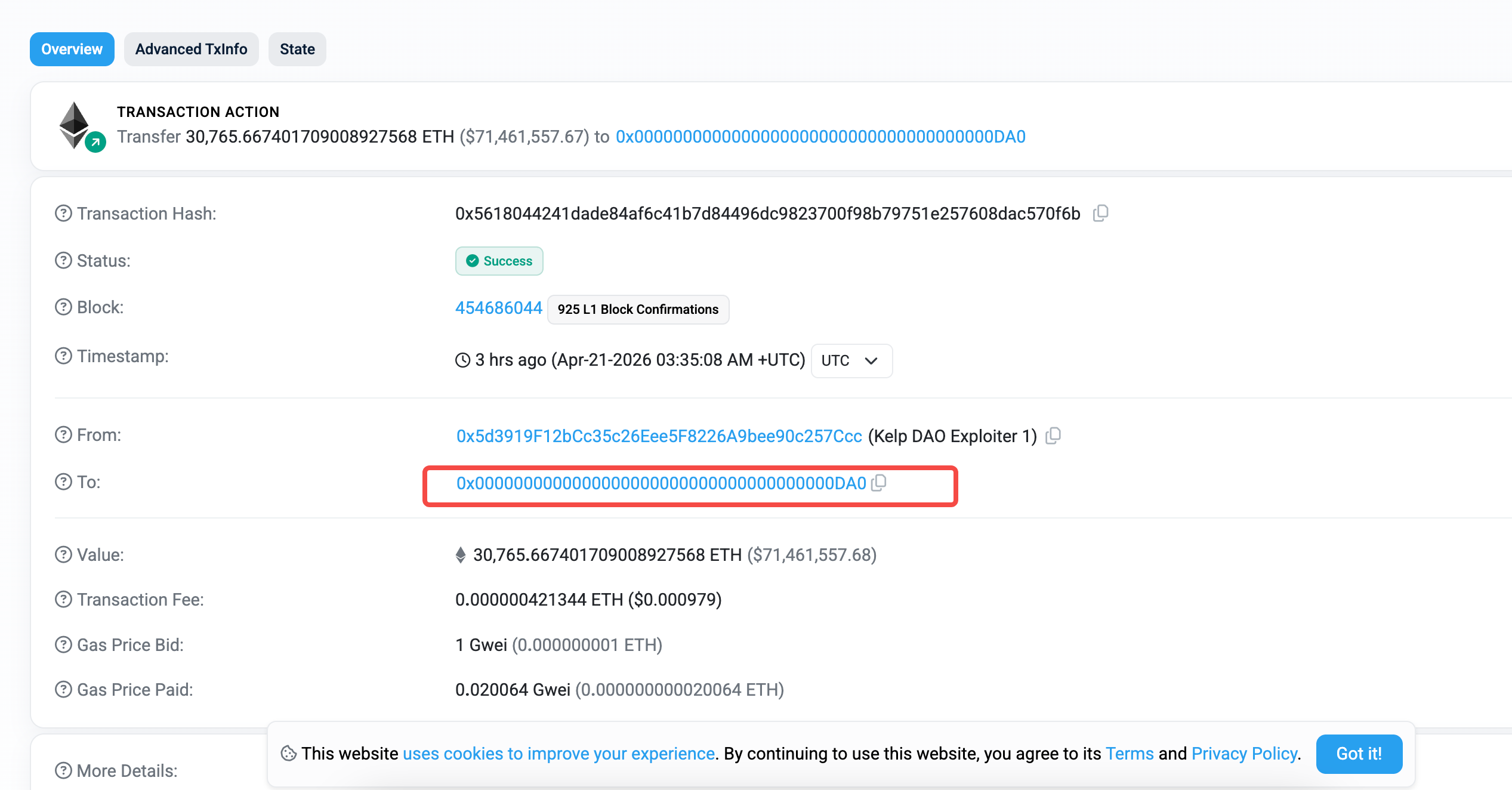
At that time, everyone was speculating: Did the hacker burn the funds in a black hole address? Or did they have a change of heart or accept a bribe?
Neither.
A few hours ago, an emergency action notice was posted on the Arbitrum official forum explaining the situation. The hacker's funds were transferred by Arbitrum's Security Council.
Interestingly, without knowing the hacker's address's private key, the Arbitrum Council neither froze the hacker's funds nor had the authority to transfer them; instead, they directly issued a transfer instruction "on behalf of the hacker."
The hacker themselves was unaware, the private key was not compromised, and the on-chain records appear as if the hacker conducted the operation.
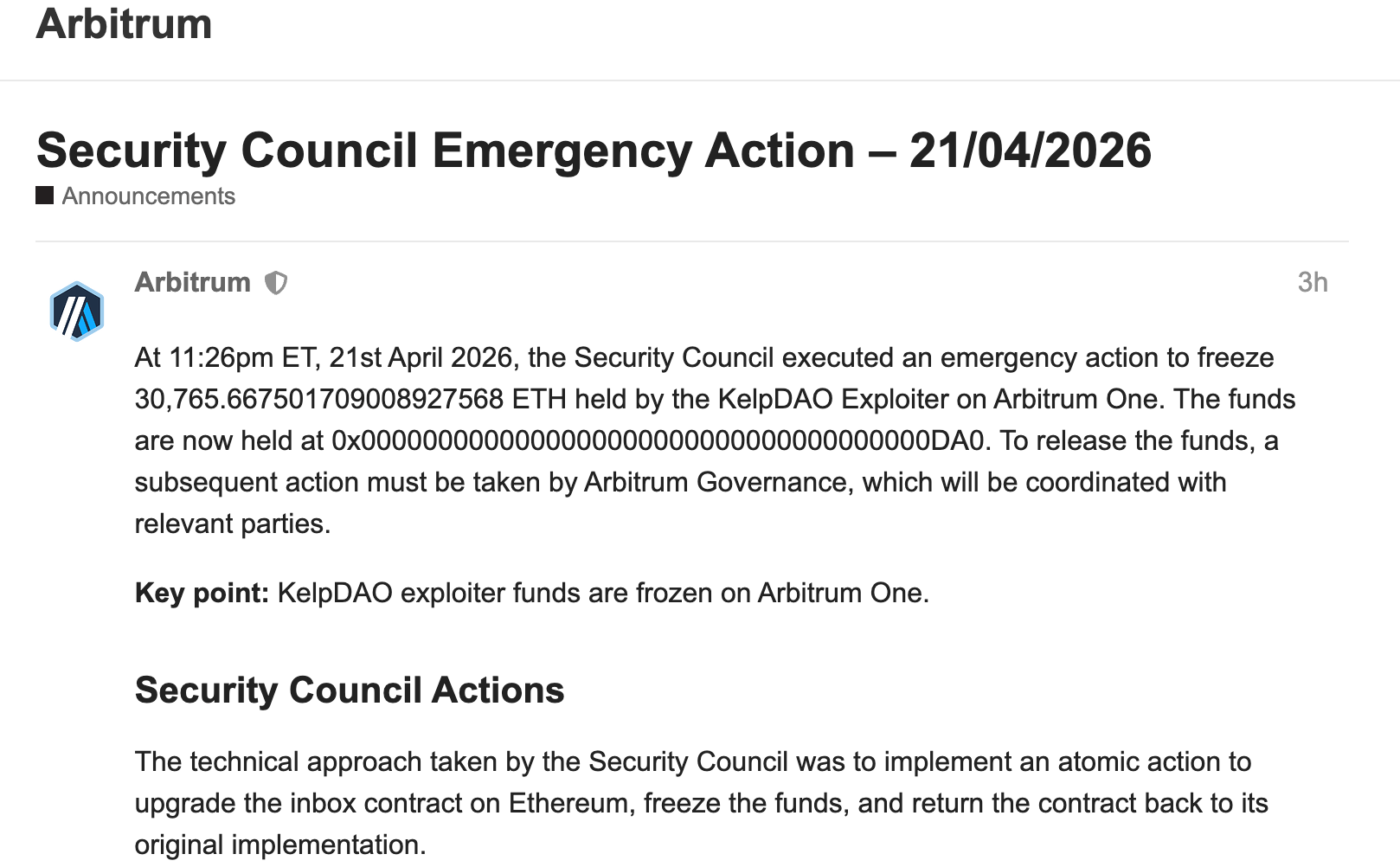
The principle behind this operation is that all cross-chain messages between Arbitrum and Ethereum go through a bridge contract called the Inbox. The Security Council used emergency powers to temporarily upgrade this contract, adding a new function:
To send a cross-chain transaction on behalf of any wallet address without requiring that wallet's private key.
They then used this function to forge a message, with the sender's address being the hacker's wallet and the content stating “Transfer all my ETH to the frozen address.” When the Arbitrum chain received it, the strange scene captured in the on-chain transfer screenshot occurred.
After transferring the hacker's funds, the contract immediately self-destructed back to its original state. The upgrade, the forgery, the transfer, and the recovery were all bundled into one Ethereum transaction. Other users and applications were not affected at all.
This operation has no precedent in Arbitrum's history.
According to a forum announcement, the Security Council had confirmed the hacker's identity with law enforcement in advance, pointing to the North Korean Lazarus Group, the most active state-level hacker organization in the DeFi space this year. The council conducted a technical assessment, ensuring no impact on other users before taking action.
Since the hacker acted maliciously first, this move is somewhat akin to a "no honor among thieves" situation. As for how to handle the frozen ETH in the future, it will go through a vote in Arbitrum's DAO governance process, in coordination with law enforcement.
Being able to recover over $70 million in stolen funds is certainly a positive outcome. However, it's worth noting the precondition for achieving this: among the 12 members of the Security Council, 9 signatures are sufficient to bypass any governance vote and smoothly upgrade any core contract on the chain.
Applauding the outcome, Concerns about authority?
Currently, the community's response to this incident is quite divided.
Some see Arbitrum's actions as commendable, protecting assets at a critical moment and even boosting confidence in L2. Others pose a direct question: if 9 signatures can move any assets in anyone's name, does this still qualify as decentralization?
From the author's perspective, both sides are not actually discussing the same thing.
The former is talking about the outcome, while the latter is discussing authority. The outcome of this incident is undoubtedly positive, with over $70 million in stolen funds recovered. However, the ability demonstrated by Arbitrum this time with the multi-signature contract function is neutral in itself; how it will be used in the future, what it can do, and how it can be done actually depend on the committee's governance.
However, for most users of Arbitrum, this discussion may not be as practical without another fact. Arbitrum is not unique in this aspect, as most mainstream L2 solutions currently retain similar emergency upgrade capabilities.
The chain you are using most likely also has a similar Security Council with similar capabilities. This is not a unique choice for Arbitrum. At this current stage, most L2 solutions have this common design.
Looking at it from a different perspective, this attack and defense has actually revealed a larger picture.
The attacker was North Korea's Lazarus Group, which has been attributed to at least 18 DeFi attacks this year. Just three weeks ago, they stole $285 million from Drift Protocol using a completely different method.
On one side, state-level hackers are continuously upgrading their attack methods, while on the other side, L2 is beginning to use underlying permissions to fight back. The security battle in DeFi is transitioning from "post-attack freezing, on-chain announcements, praying for whitehat intervention" to a new stage.
In a very extraordinary move, a universal key was created to unlock the hacker's address, and after the task was completed, the key was destroyed. Just based on this incident, the ability to withstand hacker attacks is not bad.
And if we must elevate the matter to a philosophical discussion of "this is not at all decentralized," then there is much to discuss. There are numerous centralized operations in the crypto industry, but this time at least, the focus was on handling the negative event and resolving the issue, rather than causing a negative event.
Returning to a more pragmatic view, KelpDAO was stolen $292 million, only over $70 million has been recovered, which is less than a quarter of the total. The remaining ETH is still scattered across other chains, over $100 million bad debt on Aave is still unresolved, and the amount rsETH holders will recover is still unknown.
Even though Arbitrum invoked its God-mode permission, it is clear that the battle is far from over.
Original Article Link
You may also like

The voice of a senior Polymarket user: In fact, we have already been surpassed by our competitors

Transcript of Dr. Han, founder of Gate, speaking at the University of Hong Kong: Breaking the Matthew Effect and Winning in Asymmetric Competition

Who will replace AAVE as the new king?

Fu Peng 2026 First Public Speech: What Exactly Are Crypto Assets? Why Did I Join the Crypto Asset Industry?

Lattice Capital Founder: Crypto VC, Seeing is Believing Because of Faith

The Pitch Is Set. So Is the Trade: CHZ, SportFi, and the UCL Window That Won't Wait
CHZ is gaining momentum as SportFi narratives accelerate alongside the UEFA Champions League(UCL) and global football cycles. This article explores how CHZ, fan tokens, and the broader SportFi ecosystem are driven by real-world events, market narratives, and capital flows—offering insights into why SportFi is emerging as one of the most dynamic sectors in crypto.

Morning Report | SpaceX acquires Cursor for $60 billion; Kalshi and Polymarket launch perpetual contract trading; NeoCognition completes $40 million financing

IMF | The Future of Stablecoins and Payments: Evidence from Financial Markets

56% Spike in Memecoin Trading Volume, Yet Shiba Inu (SHIB) Remains Static With 0 Netflow
Key Takeaways: Recent memecoin market saw a volume increase of 56%, highlighting a shift in investor interest towards…

American Airlines Praises Ripple, Surprising XRP Community
Key Takeaways: American Airlines reports exceptional results from Ripple Treasury usage. Ripple Treasury aids treasury efficiency without needing…
USDT Supply Surges to $188B as Tether Solidifies Stablecoin Dominance
Key Takeaways: Tether’s USDT supply reaches an all-time high of $188 billion, maintaining its dominance in the stablecoin…

North Korea’s $500M DeFi Heist Unveils New Cyber Warfare Tactics
Key Takeaways: North Korean operatives have obtained over $500 million from DeFi platforms in under three weeks. The…

How Crypto Futures Markets Are Fueling ‘Scam Coin’ Insider Schemes
Key Takeaways: RAVE’s market cap skyrocketed to $6.7 billion before plummeting by 95% due to insider control and…

XRP Price Prediction: Wall Street Giants Eye Ripple – Should You?
Key Takeaways: Wall Street players like Mastercard and BlackRock are adopting bullish XRP positions. XRP Ledger sees a…
WOJAK Crypto Meme Coin Pumps 87% as MAXI Targets $5M: Unveiling the Trading Insights of 2026
Key Takeaways: WOJAK crypto surged 87% in 24 hours, driven by aggressive accumulation, signaling renewed interest in meme…

XRP Price Prediction: Wall Street Giants Back Ripple’s Future – Should You?
Key Takeaways: Leading Wall Street firms are showing bullish interest in XRP’s price potential. At the Digital Assets…

XRP Price Prediction: Wall Street Giants Shift Focus to Ripple
Key Takeaways: XRP Ledger is seeing massive institutional interest from giants like Mastercard and BlackRock, aligning with overall…

Protect Your Crypto: Practical Steps to Avoid Scams
Key Takeaways: Recognize red flags early by knowing scams like phishing and rug pulls. Secure your assets with…
The voice of a senior Polymarket user: In fact, we have already been surpassed by our competitors
Transcript of Dr. Han, founder of Gate, speaking at the University of Hong Kong: Breaking the Matthew Effect and Winning in Asymmetric Competition
Who will replace AAVE as the new king?
Fu Peng 2026 First Public Speech: What Exactly Are Crypto Assets? Why Did I Join the Crypto Asset Industry?
Lattice Capital Founder: Crypto VC, Seeing is Believing Because of Faith
The Pitch Is Set. So Is the Trade: CHZ, SportFi, and the UCL Window That Won't Wait
CHZ is gaining momentum as SportFi narratives accelerate alongside the UEFA Champions League(UCL) and global football cycles. This article explores how CHZ, fan tokens, and the broader SportFi ecosystem are driven by real-world events, market narratives, and capital flows—offering insights into why SportFi is emerging as one of the most dynamic sectors in crypto.


 App
App