
 Buy Crypto
- Markets
 Futures
- Spot
- Copy Trade
- Earn
- More
Evaporate $2 Trillion, U.S. Stocks See Worst Start in 4 Years, Why is the Market Bearish?

At the close of the U.S. stock market last weekend, seven stocks saw all their year-to-date gains wiped out, with none spared. According to Yahoo Finance data, Tesla is down 26.4% YTD, Microsoft down 15%, Meta down 15.2%, NVIDIA down 10%, Amazon down 9.5%, Google down 9%, Apple down 2%. Looking at broad market data, the S&P 500 has seen five consecutive weeks of decline, hitting a seven-month low, with a YTD cumulative decrease of 5.1%. The Dow Jones entered a pullback territory on that day. This marks the longest losing streak of 2022 so far.
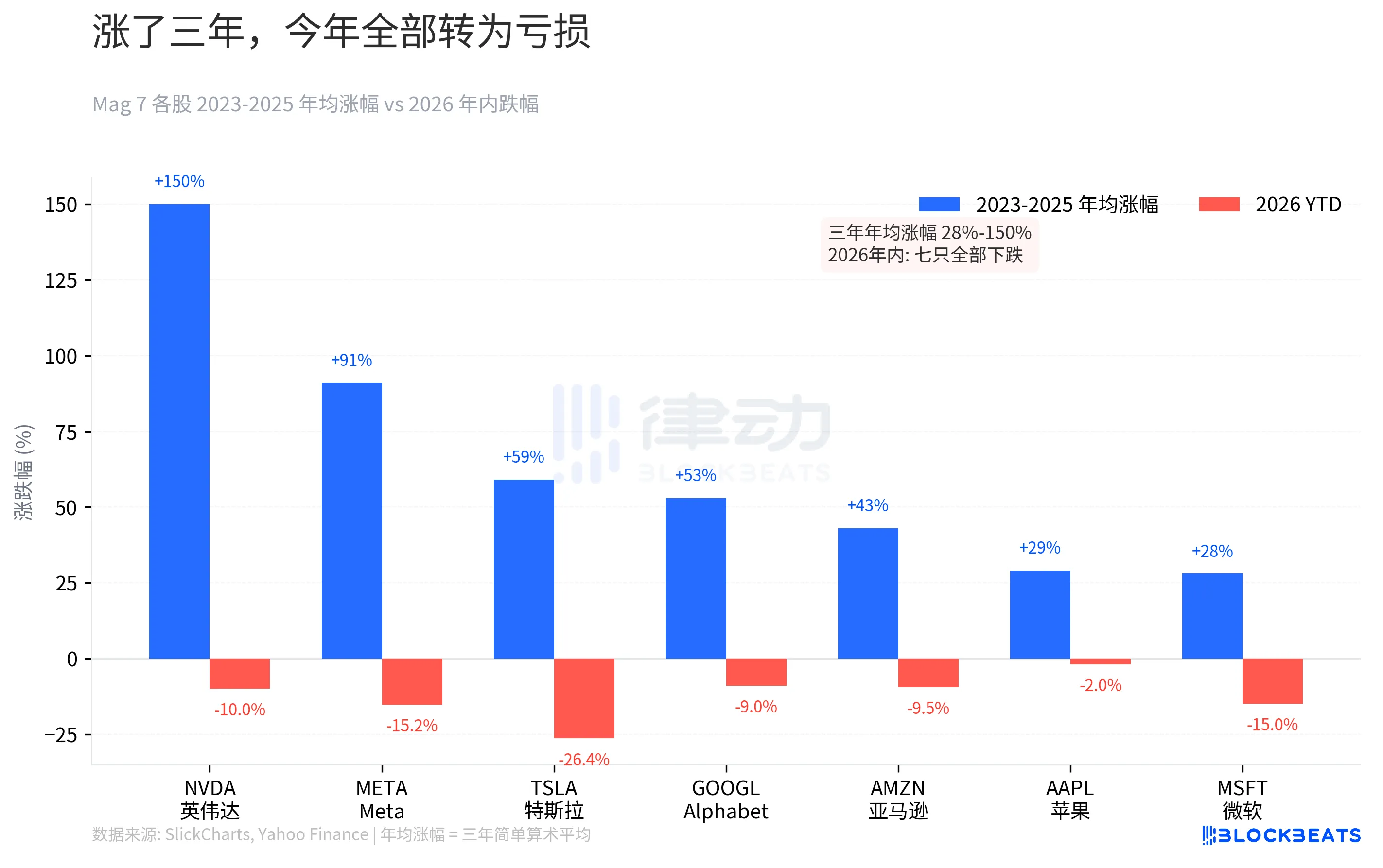
NVIDIA, which was up 239% in 2023, is now down 10% YTD. While this may seem mild, if you bought at the peak in October 2025, you would actually be down 21.2%. Meta, up 194% in 2023, is now down 15.2% from its peak. The faith accumulated during the three-year bull market has been gradually eroded in three months.
The returns in 2024 and 2025 have decelerated, from 107% to 64% to 23%. Growth has slowed, but valuations have not adjusted accordingly. When the music stopped, the risk premium ignored over the past three years came back all at once.
Rate Hike Expectation Reversal: From Single Digits to 52% in Just Three Months
The stock price decline is just a consequence. The real reversal is in interest rate expectations.
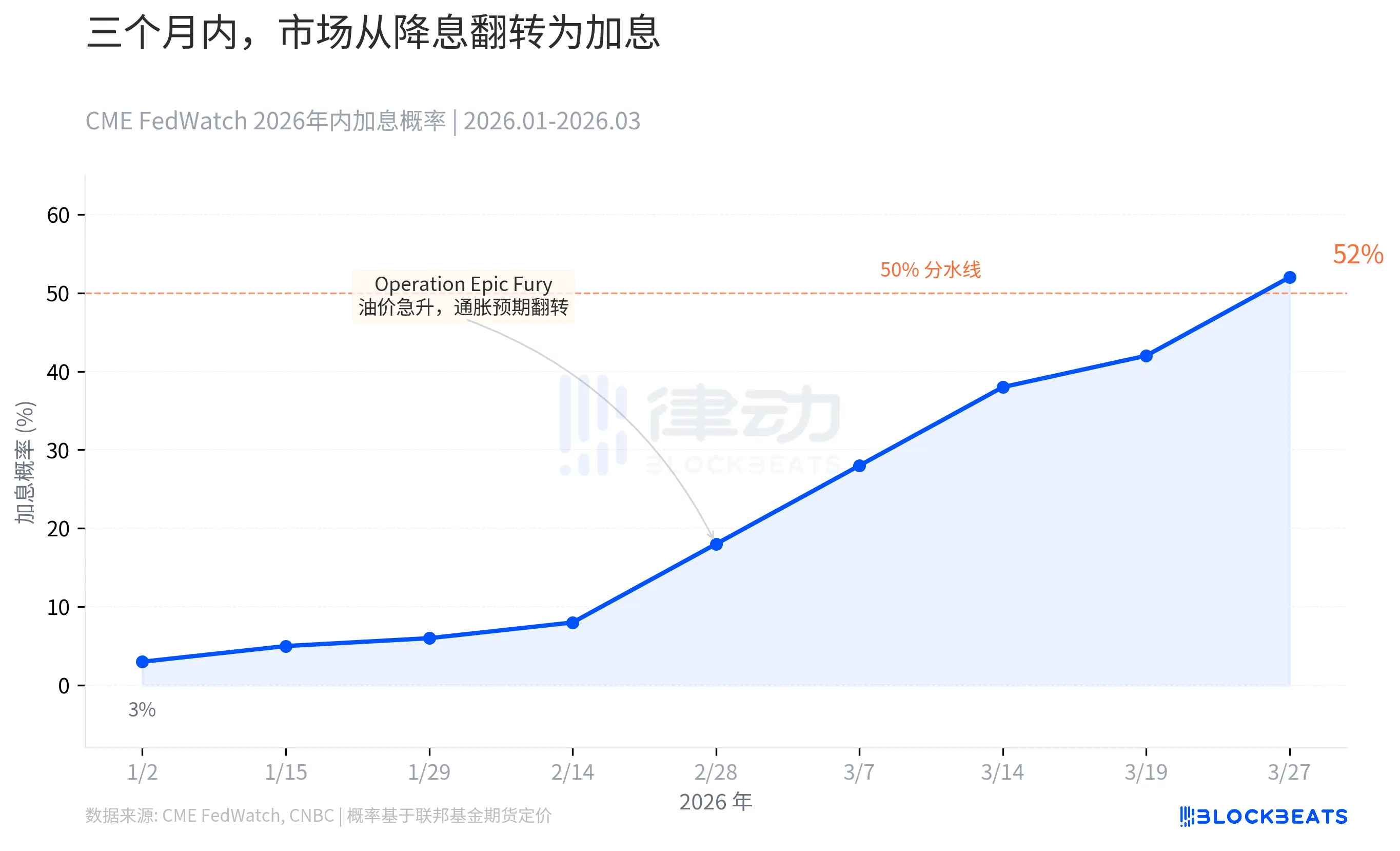
According to CME FedWatch data, in early January 2026, the market was still pricing in rate cuts, with the probability of a rate hike YTD at less than 3%. The consensus at the end of 2025 was that the Fed would continue cutting rates in 2026.
The turning point began on February 28th. The "Operation Epic Fury" triggered an escalation in the situation in the Strait of Hormuz, a chokepoint that carries 20% of global oil shipments, came under direct threat. Brent crude closed at $112.57 on March 27th, up 45% YTD. Rising oil prices fueled inflation expectations, which in turn directly reshaped rate pricing.
On March 27th, the CME futures market priced in a YTD rate hike probability exceeding 50%, reaching 52%. This marks the first time since early 2023 that the market has shifted from an "rate cut expectation" to a "rate hike expectation." According to the Atlanta Fed's Market Probability Tracker data, the probability of a 25 basis point rate hike has reached 19.8%.
From nearly zero to over half in less than three months. At the beginning of the year, there was still discussion about cutting interest rates several times, but now the discussion is about whether to raise rates.
Microsoft Drops the Most, Not Tesla
Your intuition would tell you that Tesla should be the hardest hit in the Mag 7. It has the biggest fluctuations and the most controversies. But the data presents a different reality.
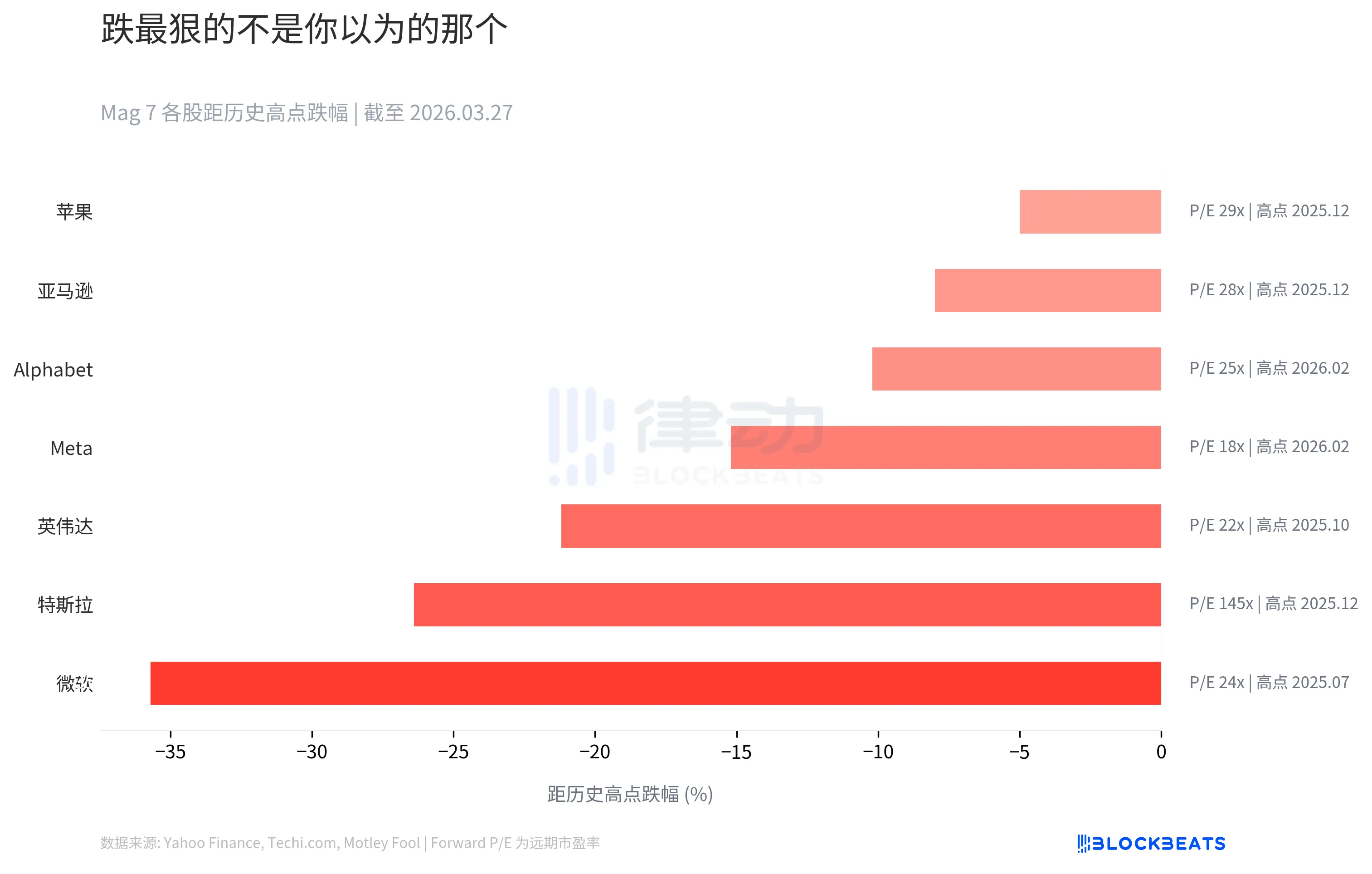
According to data from Techi.com and Motley Fool, Microsoft has dropped by 35.7% from its July 2025 peak (around $534), making it the largest percentage drop among the Mag 7 from their historical highs. Tesla ranks second with 26.4%, and Nvidia ranks third with 21.2%.
Looking at the Forward P/E column on the right, the story becomes more complex. Tesla's forward P/E is 145 times, while Microsoft's is only 24 times. Microsoft dropped more because the market priced in its expectations more rigidly. When the overall environment deteriorates, the "certainty premium" actually contracts the most.
Apple is the most resistant to decline among the seven, only falling 5% from its peak. But with a Forward P/E of 29 times, this "safety" is not cheap.
$650 Billion AI Capital Expenditure: Burning Money Is Not the Issue, It's Return Expectations
In 2026, the Mag 7 wrote themselves an unprecedented check.
According to the Q4 2025 financial guidance of each company and data compiled by Bloomberg, the 2026 AI capital expenditure budgets of the four companies Amazon, Google, Microsoft, and Meta total approximately $650 billion, a 67% increase from 2025's $381 billion. Each company's budget this year is close to or exceeds the sum of the past three years.
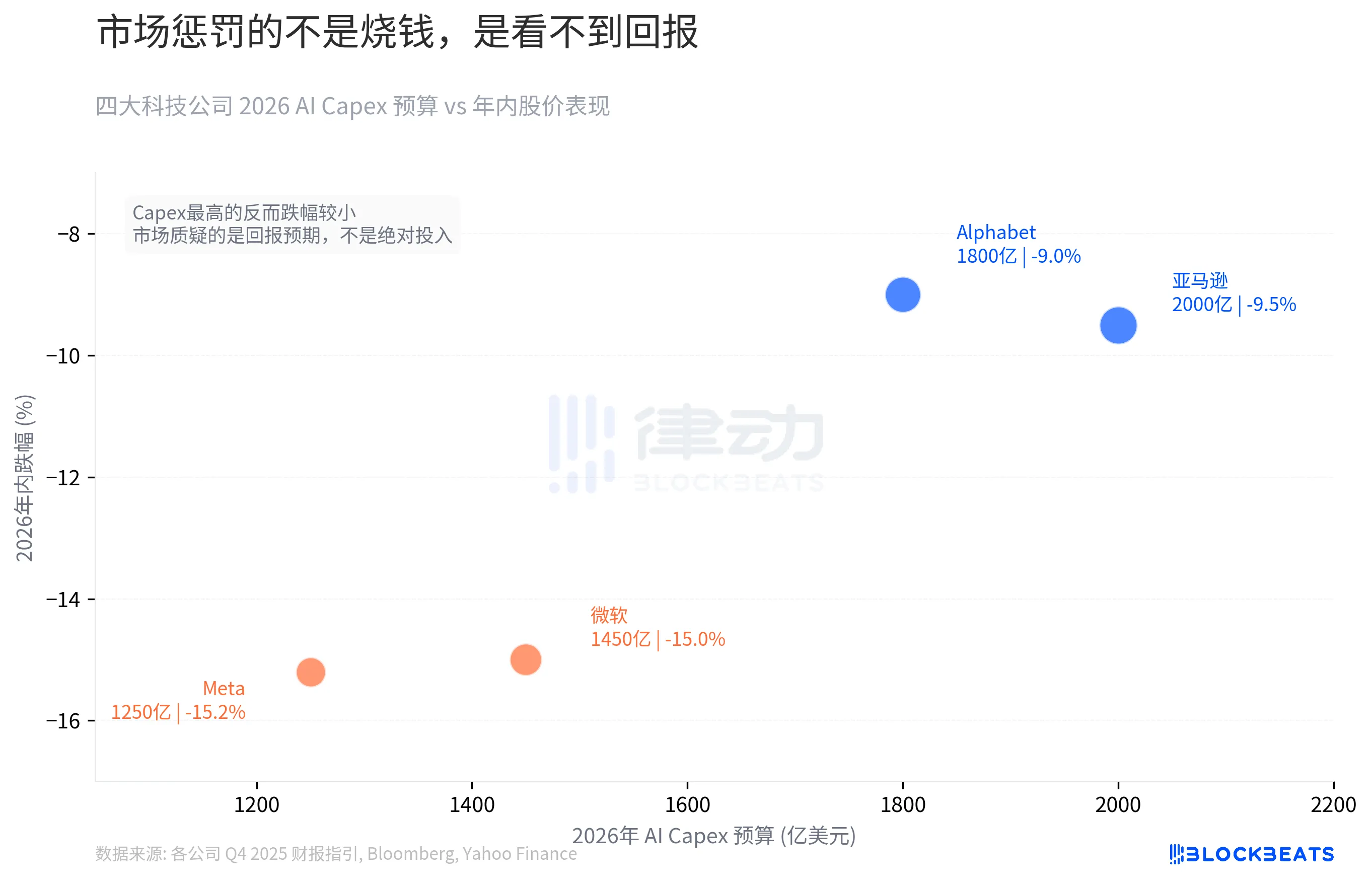
Amazon, with the largest Capex of $200 billion, and Google, with $180 billion, only dropped by 9.5% and 9% during the year. On the other hand, Microsoft with $145 billion and Meta with $125 billion in Capex saw drops of 15% and 15.2%, despite lower Capex. Spending more results in less drop.
The market's punishment is not based on the absolute scale of investment but on the visibility of returns. Amazon's AI investment directly serves its cash flow engine, AWS, and Google's investment has a clear monetization path through search advertising. Where Microsoft's and Meta's AI expenditures land is still a guessing game for investors. From Copilot's enterprise penetration to the metaverse's strategic shift to AI agents, none of these have yet materialized into numbers. The interest rate hike cycle doesn't wait for the story to unfold.
The Money Has Spoken by Walking
According to State Street Global Advisors' monthly fund flow data, year-to-date 2026, ETF net inflows into cyclical sectors such as Energy, Materials, and Industrials have reached $19 billion, accounting for 65% of all sector ETF inflows, far exceeding these sectors' 47% market weight. According to Morningstar data, Natural Resources funds saw $7.5 billion in inflows in January, marking a sector's monthly historical high.
According to ETF Trends data, cyclical sectors have seen an average year-to-date gain of +20%, while the Technology sector is down 6% year-to-date, and the S&P 500 as a whole is up only +0.5%. The Aerospace & Defense ETF (SHLD) saw over $10 billion in net inflows in January, with a year-to-date gain of +20%. The Technology sector is not entirely bleeding out, with $6 billion in inflows in February, but the returns significantly lag behind cyclical sectors.
With interest rate expectations flipped, the $650 billion in AI spending has become the most prominent line on the balance sheet. Institutional money has started to move, heading towards Energy and Defense.
EY-Parthenon Chief Economist Gregory Daco has referred to the current situation as "multidimensional disruption." He puts the probability of a U.S. recession at 40%. Goldman Sachs at 30%, while Moody's Chief Economist Mark Zandi's number is close to 50%.
Three years of exuberance, three months of reversal, and $650 billion hanging in the balance of a tightening cycle. Was the $2 trillion market cap evaporation of Mag 7 a single day panic, or is the market repricing for a cycle that has already concluded?
You may also like

60 Essential Skills, Workflows, and Open Source Projects, the Ultimate Claude Advancement Checklist

SpaceX to Raise $75 Billion | Rewire News Nightly

PUMP Valuation Breakdown: On-chain Data Disproves the "Fake Volume" Theory, Where Does the Real Discount Come From?

Tiger Research: What AI services do cryptocurrency companies offer?

The war not only drives up oil prices but also causes Circle's stock price to soar

When agents become consumers, who will rewrite the underlying logic of internet commerce?

AI Agents in Action Summit: March 31, Hong Kong Cyberport, focusing on the deep waters of AI implementation

29 Days In, What Are America’s Options on Iran?

Flash Crash Down 97%+ with Ongoing Unlocking, WLD Completes $65 Million Off-chain Funding: Who Is Still Buying?

Bitcoin for Real Estate? Fannie Mae Teams Up with Coinbase to Launch Crypto Mortgage
Tether Hires Big Four Auditor, USDT Enters First Attestation Phase

Google AI Paper Destroys $900B Storage Stock, Accused of Faking Experiment

The speed at which AI discovers vulnerabilities has surpassed the speed at which it patches vulnerabilities.

AI Crypto Trading Bot Explained: Aurora's Multi-Factor Strategy in WEEX Hackathon
Aurora demonstrates how structured, multi-agent AI Trading systems can deliver more adaptive and resilient performance in the WEEX AI Trading Hackathon.

Cyber Taoist Fortune Teller: Fake Taoist, AI Fortune Telling, and Northeastern Metaphysics History

Bloomberg: Stablecoin Payments Emerge as Crypto VC's Newest Favorite Thing
BeatSwap is evolving towards a full-stack Web3 infrastructure, covering the entire lifecycle of IP rights.
BeatSwap, a global Web3 Intellectual Property (IP) infrastructure project, is attempting to overcome the current fragmentation limitations of the Web3 ecosystem, building a full-stack system that covers the entire lifecycle of IP rights.
Currently, most Web3 projects are still in the stage of functional fragmentation, often focusing only on a single aspect, such as IP asset tokenization, transaction functionality, or a simple incentive model. This structural dispersion has become a key bottleneck hindering the industry's scale application.
BeatSwap's approach is more integrated, integrating multiple core modules into the same system, including:
· IP authentication and on-chain registration
· Authorization-based revenue sharing mechanism
· User-engagement-driven incentive system
· Transaction and liquidity infrastructure
Through the above integration, the platform builds an end-to-end closed-loop path, allowing IP rights to complete a full cycle of "creation, use, and monetization" within the same ecosystem.
BeatSwap is not limited to existing crypto users but is attempting to take the global music industry as a starting point, actively creating new market demand. Its core strategies include:
Exploring and incubating music creators (Artist discovery)
Building a fan community
Igniting IP-centric content consumption demand
The current global music industry is valued at around $260 billion, with over 2 billion digital music users. This means that the potential market corresponding to the tokenization and financialization of IP far exceeds the traditional crypto user base.
In this context, BeatSwap positions itself at the intersection of "real-world content demand" and "on-chain infrastructure," attempting to bridge the structural gap between content production and financial flow.
BeatSwap's upcoming core product "Space" is scheduled to launch in the second quarter of 2026. This product is defined as the SocialFi layer in the ecosystem, aiming to directly connect creators with users and achieve deep integration with other platform modules.
Key designs include:
A fan-centric interactive mechanism
Exposure and distribution logic based on $BTX staking
User paths connected to DeFi and liquidity structures
Thus, a complete user behavior loop is formed within the platform: Discovery → Participation → Consumption → Rewards → Trading
$BTX is designed to be a core utility asset within the ecosystem, rather than just a simple incentive token, with its value directly tied to platform activity and IP use cases.
Main features include:
· Yield distribution based on on-chain authorized actions
· Value reflection based on IP usage and user engagement dynamics
· Support for staking and DeFi participation mechanisms
· Value growth driven by ecosystem expansion
With the increased frequency of IP use, the utility and value support of $BTX will enhance simultaneously, helping alleviate the "disconnect between value and utility" issue present in traditional Web3 token models to some extent.
Currently, $BTX has been listed on several mainstream exchanges, including:
Binance Alpha
Gate
MEXC
OKX Boost
As the launch of "Space" approaches, BeatSwap is actively pursuing more exchange listings to further enhance liquidity and global accessibility, laying a foundation for future market expansion.
BeatSwap's goal is no longer limited to the traditional Web3 narrative but aims to target over 2 billion digital music users and a trillion KRW-scale content market.
By integrating content creators, users, capital, and liquidity into a blockchain framework centered around IP rights, BeatSwap is striving to build a next-generation infrastructure focused on "IP tokenization."
BeatSwap integrates IP authentication, authorization distribution, incentive mechanism, transaction system, and market construction to establish a unified structure that bridges the full lifecycle path of IP rights.
With the launch of the Q2 2026 "Space," the project is expected to become a key infrastructure connecting content and finance in the IP-RWA (Real World Assets) track.



 App
App