
- Buy Crypto
- Markets
 Futures
- Spot
- Copy Trade
 Earn
Earn- More
Solana 2025 Report Card: $15 Billion Annual Revenue, Surpassing Hyperliquid+ Ethereum Total

Original Title: "Solana 2025 Report Card: Annual Revenue of 15 Billion USD, Surpassing Total of 'Hyperliquid+Ethereum'"
Original Author: Wenser, Odaily Planet Daily
The year 2025, belonging to the world of cryptocurrency, has passed. In this year, apart from a series of bullish developments at the policy level, the on-chain ecosystem has seen rapid growth.
From the Meme coin craze sparked by Pump.fun, to the on-chain Perp DEX trend led by Hyperliquid, and further to the stablecoin and PayFi financial wave driven by Circle (CRCL) listing, the on-chain ecosystems of many public chains have also entered a period of explosive growth. Among them, Solana, with its ecosystem vitality, foundational infrastructure development, and an "application-first" internet-style capital network positioning, surpassed Ethereum and ascended to the "annual new king of on-chain networks."
Odaily Planet Daily will, in this article, sort through Solana's on-chain ecosystem, attempting to explore the "best business model" in the current crypto market (Odaily Note: Different data sources and statistical methods, for reference only).
Solana On-Chain Revenue Exceeds 6 Billion USD, Outperforming Ethereum, TRON to Become the "Strongest Public Chain"
When discussing Solana's "year-end report card," we must start from the perspective of public chain revenue. Although the price of SOL has dropped after reaching a new high near $300 last year, with the highest rebound not even reaching $270, from the perspective of public chain operation, its blood-making ability has indisputably taken the top spot.
In 2025, Solana's On-Chain Fee Revenue Surpasses 6 Billion USD
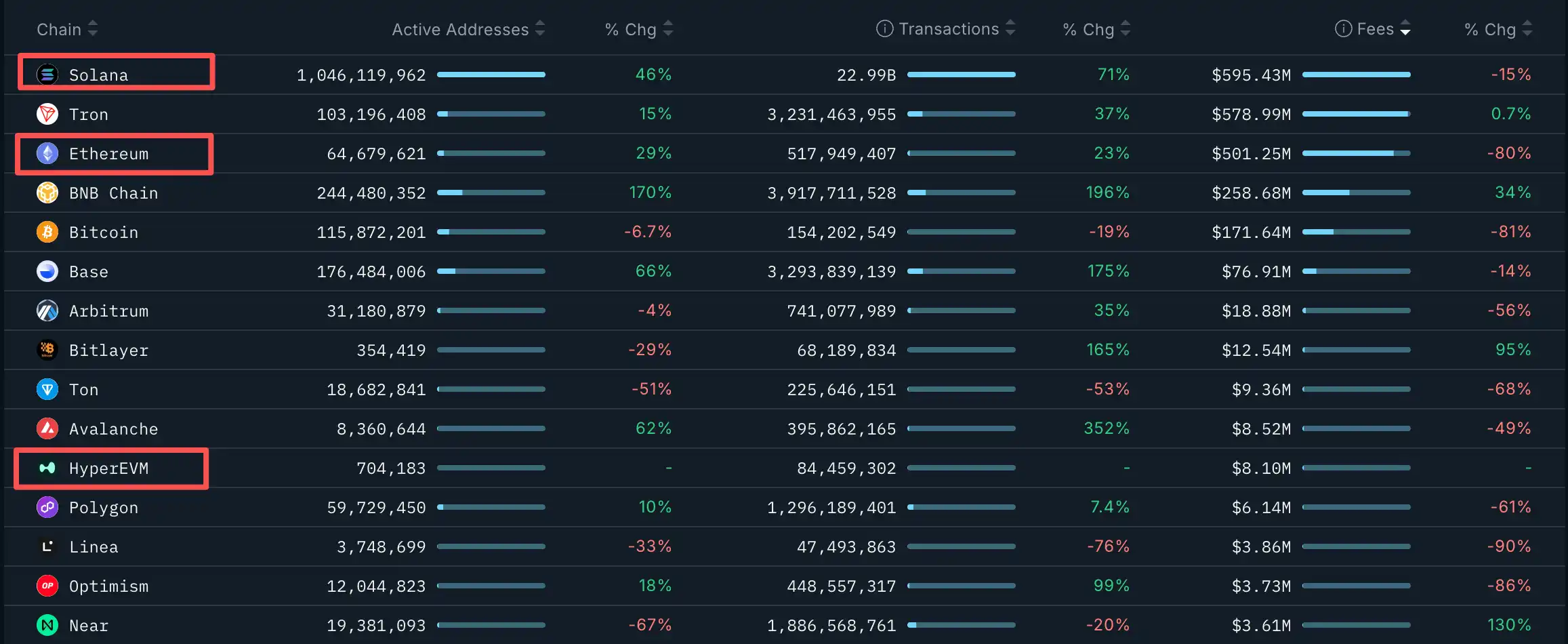
On January 2, Nansen data showed that in 2025, Solana's on-chain fee revenue surpassed 6 billion USD, ranking first ahead of TRON and Ethereum. The top five blockchains in on-chain fee revenue last year were:
· Solana (6.03 Billion USD);
· TRON (5.81 Billion USD);
· Ethereum (5.14 Billion USD);
· BNB Chain (2.59 Billion USD);
· Bitcoin (1.72 Billion USD).
Additionally, Solana had over 1.05 billion active on-chain addresses and approximately 23.01 billion on-chain transactions, both higher than Ethereum, Bitcoin, Tron, and other public chains.
The latest data shows that as of the time of writing, Solana maintains its top position in active addresses, transaction count, fee revenue, and more over the past year.
In 2025, Solana's Annual Revenue Exceeds $15 Billion, Surpassing the Combined Revenue of "Hyperliquid+Ethereum"
According to Blockworks Research data, Solana's annual revenue in 2025 exceeded $15 billion, leading all public chain networks, with Hyperliquid following closely at $7.8 billion and Ethereum generating $6.9 billion during the same period, both behind Solana. What's even more remarkable is that Solana, achieving this revenue milestone, still maintains a median transaction fee of less than 1 cent.
In response to this, Solana co-founder Anatoly Yakovenko acknowledged this achievement and pointed out that scalability and cost efficiency are core drivers. He believes that network scale, rather than high fees, supports sustainable revenue expansion.
In 2025, Solana's On-Chain Spot Trading Volume Reaches $16 Trillion, Surpassing All CEXs Except Binance
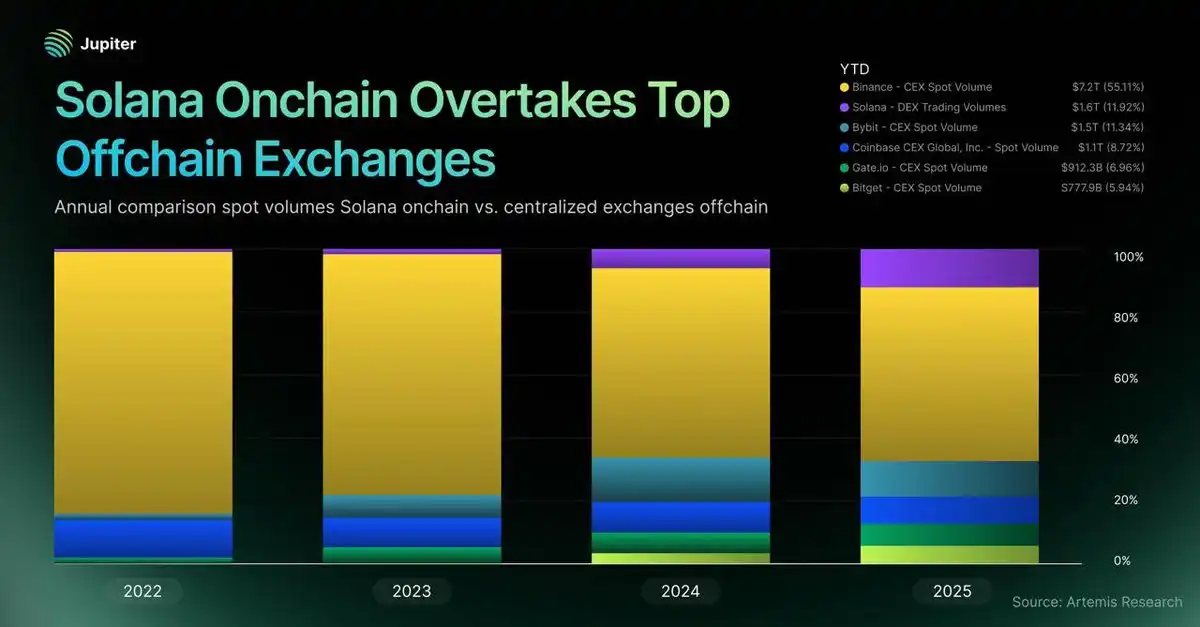
Recently, The Kobeissi Letter published an article stating that in 2025, Solana's on-chain spot trading volume officially reached $16 trillion, surpassing all centralized exchange platforms except Binance.
According to JupiterExchange data, since 2022, Solana's on-chain trading volume as a percentage of total volume has grown from 1% to 12%. In 2025, Solana's total trading volume officially surpasses that of Bybit, Coinbase Global, and Bitget, second only to Binance.
At the same time, Binance's market share has dropped from 80% to 55% since 2022. This also indicates that activity within the cryptocurrency industry is rapidly shifting on-chain.
Decoding Solana's Ecosystem Revenue Composition: 4 Key Elements Supporting Over $6 Billion
Based on existing information, Solana's network revenue primarily comes from on-chain transaction fees. In contrast to Ethereum and others, its fee mechanism design emphasizes deflation and validator incentives. The composition of the $6.03 billion total fee revenue in 2025 is as follows:
First Revenue: Base Fee
· A minimal fixed base fee is charged per transaction (around 5000 lamports).
· This fee is entirely burned, not distributed to validators, directly reducing the SOL total supply and creating deflationary pressure.
· It accounts for a significant portion of the total fee revenue, especially in the explosive transaction volume of 2025, significantly enhancing SOL's scarcity through the burning mechanism.
Second Revenue: Priority Fee
· An optional additional fee users can pay to expedite transaction confirmation.
· During high congestion periods (e.g., meme coin frenzy, DEX large trades), the priority fee escalates significantly, becoming a major source of revenue increment.
· This fee is distributed to block producers (Leaders) and stakers, serving as the primary reward for validators.
Third Revenue: MEV (Maximal Extractable Value) Related Revenue
· Through MEV clients like Jito, the fees paid by searchers further supplement revenue.
· In 2025, MEV revenue share has increased, closely tied to the complex arbitrage opportunities in DEX and meme coin trades.
Fourth Revenue: Other Minor Sources
Such as account rent (storage fees), voting fees, etc., with a relatively small share.
In the overall allocation mechanism, about 50% of fees indirectly benefit all SOL holders through the burning mechanism (deflation); about 50% are directly distributed to validators and stakers to incentivize network security. Unlike Ethereum's ecosystem where most of the revenue fees go to validators, Solana's burning mechanism makes its network revenue more capable of capturing long-term value, which is also key to maintaining low fees under high transaction volumes.
Crypto Money-Grabbing Machine Business Model Inventory: Public Chains, Perp DEX, Launchpads Remain the Most Profitable Tracks, Second Only to Stablecoins
Finally, from a comprehensive view of the current market information, public chains (Solana, Ethereum, TRON), on-chain perp DEXes (like Hyperliquid, Aster, etc.), and on-chain Launchpads (like Pump.fun) continue to be the most profitable tracks in the crypto industry, second only to stablecoin projects that earn interest and have stable issuance.
Although we have previously analyzed and explained the embarrassing survival status of current public chain projects in the article "Only 10 Public Chains with Weekly Revenue Exceeding $100,000: Group Skinny Dipping After the Tide Recedes," the existence of public chains such as Solana, Ethereum, TRON, Base, etc., tells us that public chains are still the most profitable crypto track at present, with no equal.
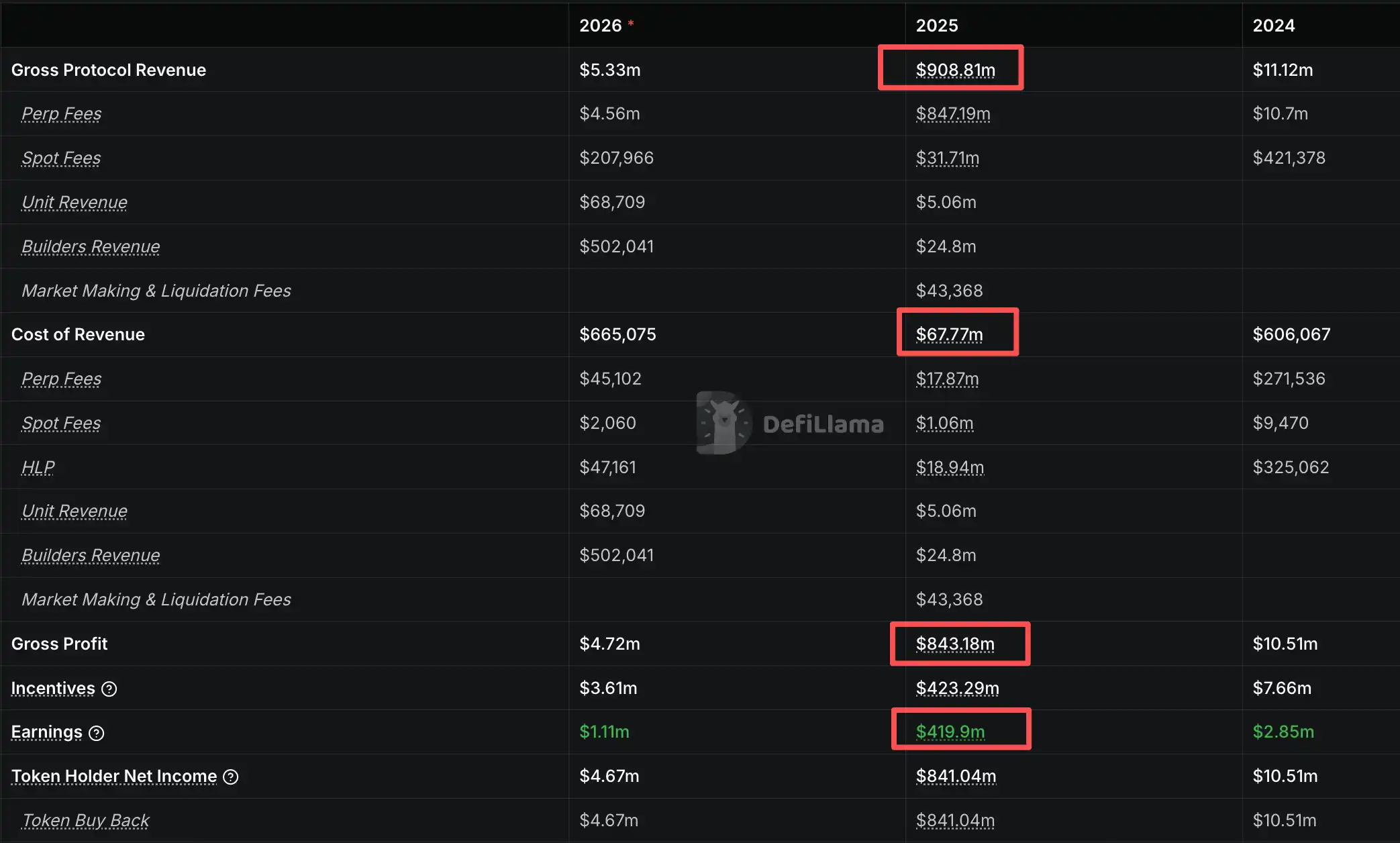
According to DefiLlama data, Hyperliquid's revenue in 2025 was $9.08 billion; revenue costs were about $67.77 million, annual net profit was about $8.43 billion, excluding incentive expenditures, and the net profit returned to the platform in 2025 was as high as about $4.2 billion.
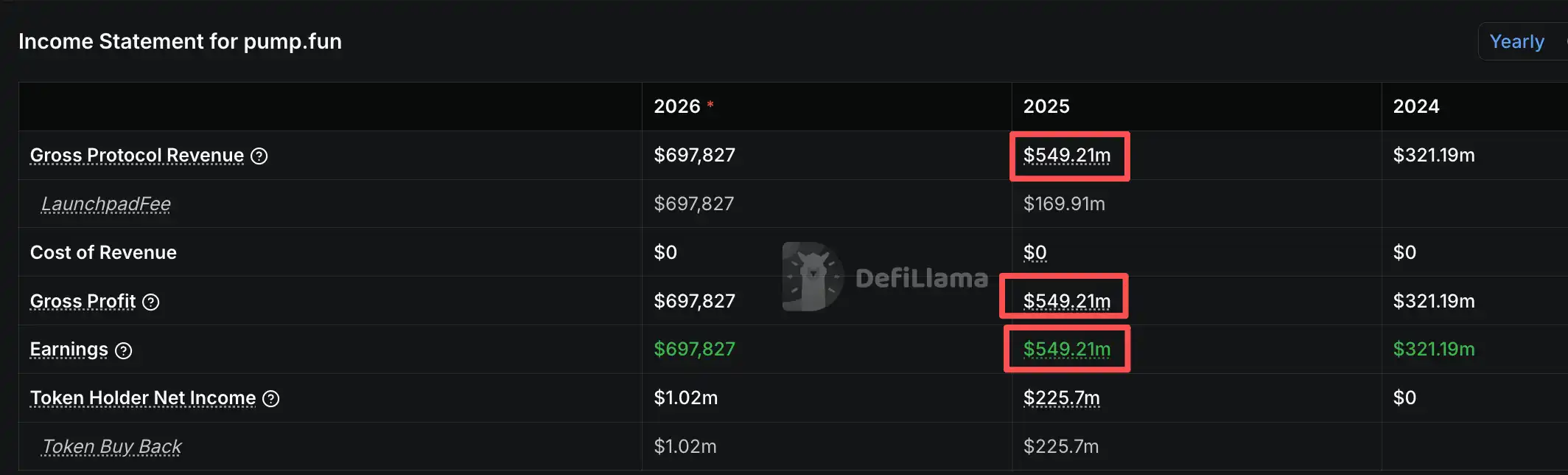
According to DefiLlama data, Pump.fun's 2025 revenue is approximately $5.5 billion. Different from on-chain perp DEX platforms like Hyperliquid, as a "one-click token issuance platform," Pump.fun does not need to spend incentive fees, so its annual net profit is approximately equal to its annual revenue, i.e., $5.49 billion.
From the above information, it can be seen that the mainstream industry's cash cow is still public chains, on-chain Perp DEX, and Launchpad token issuance platforms, second only to stablecoins (for example, Tether's net profit related to the stablecoin sector alone in 2025 is as high as $7.43 billion).
You may also like

February 9th Market Key Intelligence, How Much Did You Miss?

After being questioned by Vitalik, L2s are collectively saying goodbye to the "cheap" era

WEEX AI Trading Hackathon Paris Workshop Reveals: How Retail Crypto Traders Can Outperform Hedge Funds
Witness how WEEX's Paris AI Trading Hackathon revealed AI's edge over human traders. Explore key strategies, live competition results & how to build your own AI trading bot.

U.S. Oil (USOR) Price Prediction 2026–2030
Key Takeaways U.S. Oil (USOR) is a speculative Solana-based crypto project that aims to index the United States…

USOR Surges on Meme Narrative Despite No Real-World Asset Backing
Key Takeaways: USOR, a Solana-based token, has seen a notable surge driven by speculative narratives rather than verifiable…

How to Buy U.S. Oil Reserve (USOR) Cryptocurrency
Key Takeaways U.S. Oil Reserve (USOR) is a Solana-based token primarily traded on decentralized exchanges (DEXs). Claims have…

USOR vs Oil ETFs: Understanding Why the ‘Oil Reserve’ Token Doesn’t Track Crude Prices
Key Takeaways The U.S. Oil Reserve (USOR) token has become noteworthy for its claims, yet it does not…

Trend Research Reduces Ether Holdings After Major Market Turbulence
Key Takeaways: Trend Research has significantly cut down its Ether holdings, moving over 404,000 ETH to exchanges recently.…
Investors Channel $258M into Crypto Startups Despite $2 Trillion Market Sell-Off
Key Takeaways: Investors pumped approximately $258 million into crypto startups in early February, highlighting continued support for blockchain-related…
NBA Star Giannis Antetokounmpo Becomes Shareholder in Prediction Market Kalshi
Key Takeaways: Giannis Antetokounmpo, the NBA’s two-time MVP, invests in the prediction market platform Kalshi as a shareholder.…

Arizona Home Invasion Targets $66 Million in Cryptocurrency: Two Teens Charged
Key Takeaways Two teenagers from California face serious felony charges for allegedly attempting to steal $66 million in…

El Salvador’s Bukele Approval Reaches Record 91.9% Despite Limited Bitcoin Use
Key Takeaways: El Salvador President Nayib Bukele enjoys a record high approval rating of 91.9% from his populace,…

Crypto Price Prediction for February 6: XRP, Dogecoin, and Shiba Inu’s Market Movements
Key Takeaways: The crypto market experienced a notable shift with Bitcoin’s significant surge, impacting altcoins like XRP, Dogecoin,…

China Restricts Unapproved Yuan-Pegged Stablecoins to Maintain Currency Stability
Key Takeaways: China’s central bank and seven government agencies have banned the issuance of yuan-pegged stablecoins abroad without…

Solana Price Prediction: $80 SOL Looks Scary – But Smart Money Just Signaled This Might Be the Bottom
Key Takeaways Despite Solana’s descent to $80, some traders find security as smart money enters the fray, suggesting…

XRP Price Prediction: Major Ledger Upgrade Quietly Activated – Why This Could Be the Most Bullish Signal Yet
Key Takeaways: The activation of the Permissioned Domains amendment on XRPL represents a significant development in XRP’s potential…

Dogecoin Price Prediction: Death Cross Confirmed as DOGE Falls Below $0.10 – Is DOGE Reaching Zero?
Key Takeaways The death cross event signals potential bearish trends for Dogecoin as its price dips under $0.10,…

Stablecoin Inflows Have Doubled to $98B Amid Selling Pressure
Key Takeaways Stablecoin inflows to crypto exchanges have surged to $98 billion, doubling previous levels amidst heightened market…
February 9th Market Key Intelligence, How Much Did You Miss?
After being questioned by Vitalik, L2s are collectively saying goodbye to the "cheap" era
WEEX AI Trading Hackathon Paris Workshop Reveals: How Retail Crypto Traders Can Outperform Hedge Funds
Witness how WEEX's Paris AI Trading Hackathon revealed AI's edge over human traders. Explore key strategies, live competition results & how to build your own AI trading bot.
U.S. Oil (USOR) Price Prediction 2026–2030
Key Takeaways U.S. Oil (USOR) is a speculative Solana-based crypto project that aims to index the United States…
USOR Surges on Meme Narrative Despite No Real-World Asset Backing
Key Takeaways: USOR, a Solana-based token, has seen a notable surge driven by speculative narratives rather than verifiable…
How to Buy U.S. Oil Reserve (USOR) Cryptocurrency
Key Takeaways U.S. Oil Reserve (USOR) is a Solana-based token primarily traded on decentralized exchanges (DEXs). Claims have…


 App
App